

Abstract
References
Sorry, not available.
Click the PDF button.
Information
Because reservoirs that supply irrigation water play an important role in water resource management, it is necessary to evaluate the vulnerability of this particular water supply resource. The purpose of this study is to provide water supply risk maps of agricultural reservoirs in South Korea using irrigation vulnerability model and cluster analysis. To quantify water supply risk, irrigation vulnerability indices are estimated to evaluate the performance of the water supply on the agricultural reservoir system using a probability theory and reliability analysis. First, the irrigation vulnerability probabilities of 1,346 reservoirs managed by Korea Rural Community Corporation (KRC) were analyzed using meteorological data on 54 meteorological stations over the past 30 years (1981-2010). Second, using the K-mean method of non-hierarchical cluster analysis and pre-simulation approach, cluster analysis was applied to classify into three groups for characterizing irrigation vulnerability in reservoirs. The morphology index, watershed area, irrigated area, and ratio between watershed and irrigated area are selected as the clustering analysis parameters. It is suggested that the water supply risk map be utilized as a basis for the establishment of risk management measures, and could provide effective information for a reasonable decision making on drought risk mitigation.
Click the PDF button.
- Publisher :The Korean Society of Agricultural Engineers
- Publisher(Ko) :한국농공학회
- Journal Title :Journal of Korean Society of Agricultural Engineers
- Journal Title(Ko) :한국농공학회논문집
- Volume : 57
- No :1
- Pages :59–67
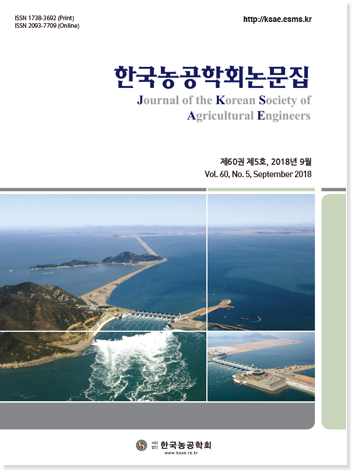 Journal of Korean Society of Agricultural Engineers