

Abstract
References
Sorry, not available.
Click the PDF button.
Information
North Korea has frequently suffered from extreme agricultural crop droughts, which have led to food shortages, according to the Food and Agriculture Organization (FAO). The increasing frequency of extreme droughts, due to global warming and climate change, has increased the importance of enhancing the national capacity for drought management. Historically, a meteorological drought index based on data collected from weather stations has been widely used. But it has limitations in terms of the distribution of weather stations and the spatial pattern of drought impacts. Satellite-based data can be obtained with the same accuracy and at regular intervals, and is useful for long-term change analysis and environmental monitoring and wide area access in time and space. The Evaporative Stress Index (ESI), a satellite-based drought index using the ratio of potential and actual evaporation, is being used to detect drought response as a index of the droughts occurring rapidly over short periods of time. It is more accurate and provides faster analysis of drought conditions compared to the Standardized Precipitation Index (SPI), and the Palmer Drought Severity Index (PDSI). In this study, we analyze drought events during 2015-2017 in North Korea using the ESI satellite-based drought index to determine drought response by comparing with it with the SPI and SPEI drought indices.
Click the PDF button.
- Publisher :The Korean Society of Agricultural Engineers
- Publisher(Ko) :한국농공학회
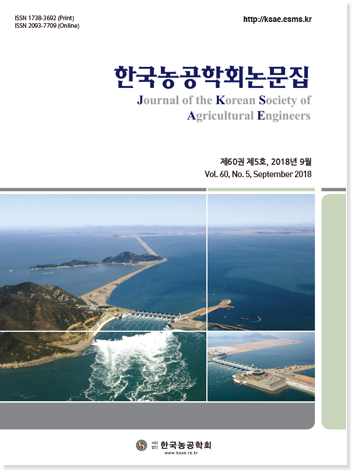
- Journal Title :Journal of Korean Society of Agricultural Engineers
- Journal Title(Ko) :한국농공학회논문집
- Volume : 61
- No :3
- Pages :1–14
- DOI :https://doi.org/10.5389/KSAE.2019.61.3.001
 Journal of Korean Society of Agricultural Engineers