

Abstract
References
Sorry, not available.
Click the PDF button.
Information
The objective of this study was to estimate the climate change impact on water quantity and quality to Saemanguem watershed using SWAT (Soil and water assessment tool) model. The SWAT model was calibrated and validated using observed data from 2008 to 2017 for the study watershed. The R2 (Determination coefficient), RMSE (Root mean square error), and NSE (Nash-sutcliffe efficiency coefficient) were used to evaluate the model performance. RCP scenario data were produced from 10 GCM (General circulation model) and all relevant grid data including the major observation points (Gusan, Jeonju, Buan, Jeongeup) were extracted. The systematic error evaluation of the GCM model outputs was performed as well. They showed various variations based on analysis of future climate change effects. In future periods, the MIROC5 model showed the maximum values and the CMCC-CM model presented the minimum values in the climate data. Increasing rainfall amount was from 180mm to 250mm and increasing temperature value ranged from 1.7 to 5.9℃, respectively, compared with the baseline (2006∼2017) in 10 GCM model outputs. The future 2030s and 2070s runoff showed increasing rate of 16∼29% under future climate data. The future rate of change for T-N (Total nitrogen) and T-P (Total phosphorus) loads presented from -26 to +0.13% and from +5 to 47%, respectively. The hydrologic cycle and water quality from the Saemanguem headwater were very sensitive to projected climate change scenarios so that GCM model should be carefully selected for the purpose of use and the tendency analysis of GCM model are needed if necessary.
Click the PDF button.
- Publisher :The Korean Society of Agricultural Engineers
- Publisher(Ko) :한국농공학회
- Journal Title :Journal of Korean Society of Agricultural Engineers
- Journal Title(Ko) :한국농공학회논문집
- Volume : 60
- No :6
- Pages :83–96
- DOI :https://doi.org/10.5389/KSAE.2018.60.6.083
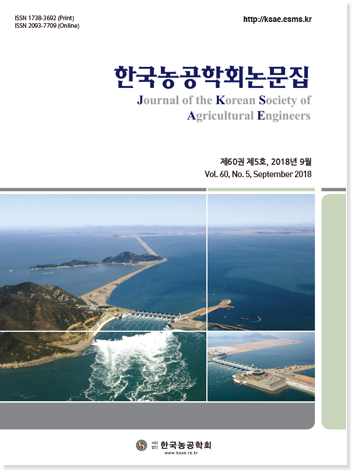 Journal of Korean Society of Agricultural Engineers