

Abstract
References
Sorry, not available.
Click the PDF button.
Information
Exposure risk assessment of pesticide molinate using the RICEWQ model in a rice paddy plot was performed to observe the effects of various water and pesticide management scenarios. Several scenarios were developed to represent the specific water and pesticide management practices of rice cultivation in Korea. The results of the scenario analysis using the RICEWQ model simulation from the previous studies were analysed. The molinate risk for aquatic organisms is evaluated by the ratio of the predicted environmental concentration(PEC) and the predicted no-effect concentration(PNEC). The results showed that the no-effect periods for aquatic organisms for the deep, shallow and very shallow irrigation conditions were 33.3, 28.9 and 25.6 DATs for the lable rate application and 36.4, 33.7 and 30.8 DATs for the double lable rate application, respectively. The higher application rate showed greater exposure risk to the aquatic organisms. Based on this study, the withholding period of molinate practiced in Korea, that is 3 to 4 DATs, must be much longer. The results of this study can be used for the non-point source pollution control and environmental policy making regarding pesticides.
Click the PDF button.
- Publisher :The Korean Society of Agricultural Engineers
- Publisher(Ko) :한국농공학회
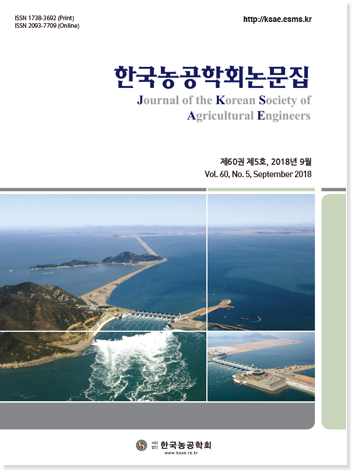
- Journal Title :Journal of Korean Society of Agricultural Engineers
- Journal Title(Ko) :한국농공학회논문집
- Volume : 50
- No :4
- Pages :17–24
 Journal of Korean Society of Agricultural Engineers