

Ⅰ. Introduction
Today, fishing villages serve as a source of seafood and a national recreational space, but their self-sustainability is insufficient due to stagnant production and lack of residents’ capacities. In order to overcome this situation, the Special Act on Support for Specialization Development in Fishing Villages was enacted in 2013, raising expectations for new fishing village development. Furthermore, a change in the fishing village policy has recently appeared due to a paradigm shift in new regional policies such as the future industrialization of traditional industries or the 6th industrialization.
However, due to the problems of fishing villages such as population decline, aging, poor facilities and poverty, and the simple income structure centered on the fishery industry, they are vulnerable to external shocks, and frequent conflicts between residents and lack of community capacity exist (Statistics Korea, 2015). Moreover, due to the simple income structure centered on the fishing industry (including short meals), it is a reality that is vulnerable to climate change and changes in the external environment. Even stability is under threat. Rural villages are traditionally a cooperative society that shares labor power, while fishing villages are a competitive society that lives with limited natural resources and is a place with relatively strong exclusivity. In order to solve these special circumstances and problems of fishing villages, the Ministry of Maritime Affairs and Fisheries has been operating the ‘Fishing Village Specialization Support Center’, an on-site dedicated organization for the self-sustaining development of the fishing village, and has been conducting diverse projects to solve the fishing village problem.
Among them, a Fishing Village Specialization Capacity Enhancement Project is being promoted at the village level so that local residents can use the tangible and intangible resources of the region to pursue sustainable village development, such as generating income. The “Fishing Village Specialization Capacity Enhancement Project” is promoted through a public offering method, aims to strengthen the project promotion capacities of selected village residents, and is being carried out step by step through capacity evaluation. Research through capacity change and satisfaction survey targeting participants in the Fishing Village Specialization Capacity Enhancement Project is a diagnosis of the current fishing village specialization capacity enhancement project, suggesting a desirable business direction and efficiency improvement plan, and enhancement the fishing village specialization capacity. It will be an important basic data in preparing the necessity and logical basis for expanding the project (Business in progress).
In this study, two villages on the inland water and two coastal villages were selected among the fishing villages in Gangwon-do, the target area of the Fishing Village Specialization Capacity Enhancement Project. Therefore, a questionnaire was conducted before and after the residents’ competency reinforcement education, and a corresponding t-test was conducted (156 person before training, 150 person after training). Through this, for the purpose of surveying the satisfaction level of training and analyzing the performance, the theoretical analysis and consideration of the effect on the status of ownership and the change of residents’ capacities through training was conducted.
Ⅱ. Previous Research
The rural development project has been carried out with a focus on hardware maintenance such as infrastructure expansion and landscape improvement. However, the importance of the software (S/W) project is gradually increasing as the regional capacity enhancement project is included in the comprehensive maintenance project such as the comprehensive maintenance project for the eup-myeon location and the comprehensive maintenance project for each region.
On the other hand, looking at the research on the enhancement of local capacity, Kang (2004) reinforced village capacity through case studies of rural village communities in Chungnam, and in order to succeed, village leaders (human), local conditions (space), and time conditions (time). It is said that it is possible only when the three elements of achieve harmony (the holy trinity). The most important factor among them is that it is necessary to establish a policy direction for sustainable development of the local community so that the local community can develop and leap forward by fostering leaders who have both innovation and ethics as innovative and trusted leaders.
Park (2007) introduces the concept of capacity enhancement and domestic and foreign cases, and, in order to cultivate capacity in rural areas, the capacity enhancement support project (practical learning project) that allows residents to creatively utilize resources and conditions and training for local leaders He said the project was urgent. Park et al. (2013) noted the importance of residents’ cooperation and regional capacity for project operation management, as there were limitations in project operation management and insufficient improvement efforts due to residents’ willingness to participate in rural area development projects and limitations of local capacity. By verifying, the direction of future business operation management was suggested.
Seo (2014) re-established the concept of the Regional Capacity Enhancement Project, and said that the current problem is the local government and the Korea Rural Community Corporation. The reason was the lack of understanding of region development officials’ ability to strengthen the region and formal projects to win orders for rural region development projects.
However, less than 10 years have passed since the introduction of the regional capacity enhancement project, many difficulties have arisen in the business operation process due to the lack of understanding of the project implementers and excessive workload of the implementation plan and execution standards in the area of regional capacity enhancement. In some cases, a question is raised about the expertise and experience of a project operator, and one person performs tasks in several regions, thereby performing a project that is more uniform than the characteristics of each region.
In the case of coastal areas, the characteristics of general fishing villages are well represented, but in the case of inland waters, the characteristics of fishing villages and rural villages are intermediate, so it is difficult to regard it as a general fishing village.
There are few studies related to the enhancement of regional capacity in fishing villages since the previous studies were reviewed, and there are few studies on inland waters. The Ministry of Agriculture and Food has conducted a capacity enhancement project and research, but the Ministry of Oceans and Fisheries is just about to start a capacity enhancement project for fishing villages. Previous studies so far have been limited to the concept of local capacity enhancement and improvement of projects, and there are few studies on project management and change of residents’ consciousness. Therefore, in light of the trend of the times and the importance of the business, it is judged that a study that can establish systematic standards and actualize project management is necessary for the efficient promotion of local capacity in fishing villages. It is necessary to systematically organize the capacity enhancement project that meets the needs and characteristics of the village according to the capacity enhancement project of the fishing village residents.
Ⅲ. Materials and Methods
1. Location of study Area
A. Location of study Area
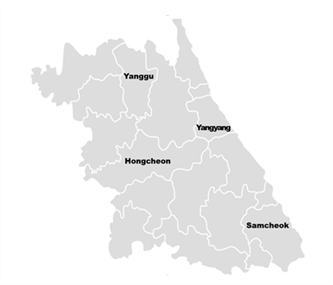
Location of study Area of the survey is the 2019 fishing village specialization capacity enhancement project district conducted by the Gangwon Fishing Village Specialization Support Center. There are 2 villages on the inland water and 2 villages on the coast. The fishing villages belonging to the coast are Yangyang Mulchi fishing village and Samcheok Jangho fishing village. The project was carried out with 4 training sessions and 1 excursion for these 4 villages. Fig. 1 shows the location of study area.
B. Study Area Characteristics
Location of study Area of this study were in inland waters (Yanggu, Hongcheon) and coastal (Yangyang, Samcheok). Looking at the meaning of legal coast and inland water, coast refers to a place connecting land and sea, and the boundary between sea and land is generally called coast, but the term coast is a large area affected by the various actions that occur at this boundary. Inland waters refer to the water flow or surface of freshwater or brackish water artificially created in rivers, dams, lakes, swamps, reservoirs, and their parks.
In general, the coastal fishing village represents the life of a generally known fishing village, and the inland water fishing village has limited fishery work by fishing in rivers and lakes, and basically has many similarities with daily life in rural villages. Although there may be differences in terms of setting and comparing the coastal and inland waters, the study was conducted by selecting two sites for each coastal and inland waters, as it was judged that it could be compared with a fishing village and a rural village.
2. Research and investigation method
In order to measure residents’ perceptions, capacity change, and survey residents’ satisfaction, a survey was conducted targeting participants in the capacity enhancement project training conducted by the Gangwon Fishing Village Specialization Center.
The survey was conducted by dividing it into before and after the start of the training, and it was possible to respond by itself considering the age and situation of the residents living in the target area. 252 copies of the distributed survey were collected before training, and 246 copies were collected and analyzed after training.
The contents of the survey consisted of 8 items on the actual condition of residents’ perception of the Gangwon Fishing Village Specialization Support Project, and 12 questions on a 5-point Likert scale as an item to evaluate residents’ capacity and satisfaction. In addition, 4 questions were composed of basic personal matters, and the survey was prepared with 12 factors related to resident capacity as discussed in the theoretical review, and the survey measurement items of resident capacity factors are as follows. As a method of setting the evaluation index, among the existing projects included in the fishing village development project group, which is the scope of this study, the evaluation index development cases and actual evaluation cases of the projects that are conducting evaluation were surveyed and analyzed to select the index candidate group. Table 1 shows the detailed items of survey investigation, and Table 2 shows the resident capacity factor measurement items.
Table 1
Detailed items of survey investigation
| Classification | Detailed items | Note | Reference |
| Resident awareness (8 questions) | Recognition of Gangwon Fishing Village Specialization Support Project/Image/Most Important Subject/Persistence in the Future | Nominal scale | Jeon (2014) |
| Resident capacity and satisfaction (12 questions) | Change Consciousness/Self-utility, Presence, Self-esteem/Self-reliance | 5 points Likert scale | Huh (2018) |
| Participation Awareness/Mutual Dialogue/Problem Solving/Sense of Control/Centered Participation/Problem Awareness/Information/Reasonable Thinking/Assertion/Self-development | Kim (2018) Lee (2013) Na (2010) Yoo et al. (2009) | ||
| Basic personal information (4 questions) | Gender/Age/Occupation/Residence Years | Nominal scale |
Table 2
Resident capacity factor measurement items
3. Analysis method
The collected survey was first subjected to basic statistics to determine the basic personal information and residents’ perceptions, and secondly, to measure the change in resident capacity, factor analysis was first performed on the survey response and then reliability was analyzed. In addition, the outcome of education was analyzed by comparing the results of the initial questionnaire and the questionnaire after training. In order to compare the averages of several groups before and after training, an corresponding sample t-test was performed on each of the four villages. SPSS 24.0 was used for statistical processing of the survey results, and the statistical significance level was determined as 0.05. t-test was performed using the average value of the questionnaire survey before and after training for each item, and it was interpreted that a significant difference was indicated when the p value of the significance probability indicated as a result was less than 0.05.
Ⅳ. Result and Consideration
1. Survey on residents’ awareness and participation (primary training)
At the first training session, 51 out of 84 respondents 4 villages (60.7%) were aware of the Fishing Village Specialization Support Project to the question ‘Do you know the Gangwon Fishing Village Specialization Support Project?’ There were many answers saying that they did not know and except in special cases, more than half of the villagers were aware of the Fishing Village Specialization Support Project. Table 3 shows the results of the survey.
2. Analysis of resident consciousness
A. Residents’ preference
1) Preference
As for the preference of residents of the Gangwon Fishing Village Specialization Support Project, only those who knew the project among the respondents to the first survey surveyed the preference. Table 4 and Fig. 2 shows the results of the first survey. Of the 153 respondents in the inland waters and coast, 147 (96%) showed positiveness of the project.
Table 4
Recognition of gangwon fishing village specialization support project Unit: No. of people (%)
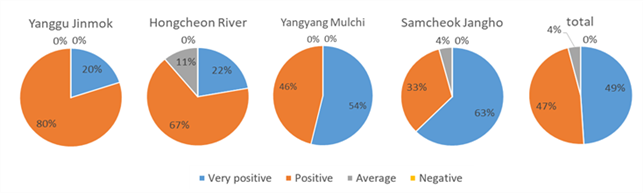
The positive reasons were surveyed for reinforcing residents’ capacities through training, creating jobs, etc., and the people who are the center of the village business were identified as village residents.
2) Reasons for preference
There were no negative responses in all four villages, but it was surveyed that residents who had disagreements and conflicts between village residents due to disagreement between village indigenous people with returnees and noble villagers did not benefit from the Gangwon Fishing Village Specialization Support Project. Table 5 shows the reasons of the positive results.
Table 5
Positive reasons for gangwon fishing village specialization support project Unit: No. of people (%)
B. The most important subject
The most important actors in Gangwon’s Fishing Village Specialization Project were 60% of residents, 40% of village leaders, 55.6% of residents in Hongcheon River, 22.2% of administration, and 11.1% of village leaders and experts in the total response of Jinmok in Yanggu. Yangyang fish in the coastal area were found in the order of 53.8% of residents, 38.5% of village leaders, and 7.7% of experts. Like other villages, Jangho of Samcheok was surveyed with 79.2% of residents, 12.5% of village leaders, and 8.3% of experts. Table 6 shows the survey results.
Table 6
An important subject of gangwon fishing village specialization support Unit: No. of people (%)
| Classification | Region | Administration | Resident | Village leader | Expert |
| Inland water | Yanggu Jinmok | 0 | 9 | 6 | 0 |
| Hongcheon River | 6 | 15 | 3 | 3 | |
| Coast | Yangyang Mulchi | 0 | 21 | 15 | 3 |
| Samcheok Jangho | 0 | 57 | 9 | 6 | |
| Total | 6 (3.9) | 96 (32.7) | 33 (21.6) | 12 (7.8) | |
C. Future sustainability
Regarding the continuity of the Gangwon Fishing Village Specialization Support Project, 153 respondents (92.2%) responded to both inland water and coastal waters, with 141 respondents (92.2%) saying that it must be maintained. Six respondents said they were not sure, and six were not interested. Table 7 shows the results of the questionnaire on future sustainability.
3. Survey on residents’ perception and participation (4th training)
A. Awareness
There may be a slight difference from the residents who surveyed during the first training, but the difference in perception after the fourth training and the first excursion increased from 60.7% of the first to 91.5% of the fishing village specialization support project. Table 8 and Table 9 shows the survey results after the 4th training.
B. Number of participation in training and field trips
For the purpose of most of Gangwon’s Fishing Village Specialization Support Projects, four training sessions and one excursion were conducted in all four regions. The participation rate was higher in the coastal area than in the coastal area, but the total number of participants was higher in the coastal area. Table 10 and Table 11 shows the current status and number of participation in training and excursion of Gangwon fishing village.
Table 10
Current status of participation in training and excursion of gangwon fishing village Unit: No. of people (%)
| Classification | Region | Respondent | Training participant |
| Inland water | Yanggu Jinmok | 33 | 33 (100.0) |
| Hongcheon River | 33 | 24 (72.7) | |
| Coast | Yangyang Mulchi | 48 | 36 (75.0) |
| Samcheok Jangho | 132 | 102 (77.2) |
Table 11
Number of participation in training and excursion of gangwon fishing village specialization support project Unit: No. of people (%)
In the case of Samcheok Jangho, it is judged that the participation of residents was higher than that of other regions, as they have experienced several village projects apart from the
ongoing Gangwon Fishing Village Specialization Support Project. In addition, it is judged that there was not much participation in the village due to the monthly (seasonal) characteristics of the village during the period during which the training of inland water was in progress.
C. Residents’ preference
1) Preference
As for the preference of residents of the Gangwon Fishing Village Specialization Support Project, only those who said they knew the project among the respondents to the 4th survey were surveyed, and 76 out of 82 respondents (90.7%) in the inland and coastal waters showed positiveness of the project. Table 12 shows the survey results.
Table 12
Recognition of gangwon fishing village specialization support project Unit: No. of people (%)
| Classification | Region | Very positive | Positive | Average | Negative |
| Inland water | Yanggu Jinmok | 3 | 12 | 0 | 0 |
| Hongcheon River | 6 | 18 | 3 | 0 | |
| Coast | Yangyang Mulchi | 21 | 18 | 0 | 0 |
| Samcheok Jangho | 45 | 24 | 3 | 0 | |
| Total | 75 (49.0) | 72 (47.1) | 6 (3.9) | 0 (0.0) | |
The positive reason was similar to that of primary training, but the proportion of reinforcing residents’ capacities through training was slightly higher, and the people who became the center of the village project were indicated as village residents. It was found that the village’s interests (important) were placed. In addition, it was investigated that village leaders such as the chairman, secretary, and head of the village should lead the village project as the subject, rather than relying on experts to follow passively.
2) Reasons for preference
The reason for the residents’ preference for the Gangwon Fishing Village Specialization Support Project was positive, in order of enhancement of residents’ capacities through training 62.2%, village environment improvement 24.4%, and job creation 13.4%. It was found that all of the four village residents in the inland water and coastal areas prefer to strengthen residents’ capacities through training. Table 13 shows the reasons of the positive results.
Table 13
Positive reasons for gangwon fishing village specialization support project Unit: No. of people (%)
D. The most important subject
The most important actors in Gangwon’s Fishing Village Specialization Support Project were 81.8% of residents, 9.1% of village leaders, 63.6% of residents in Hongcheon, and 9.1% of village leaders and experts in the total response of Jinmok in Yanggu. Yangyang Mulchi in the coastal area was found to be 38.5% of residents and village leaders, and Samcheok Jangho, like other villages, showed 47.7% of residents, 31.8% of village leaders, and 9.1% of experts. Table 14 shows the survey results.
Table 14
An important subject of gangwon fishing village specialization support Unit: No. of people (%)
E. Future sustainability
Regarding the continuity of the Gangwon Fishing Village Specialization Support Project, 225 respondents (92.2%) responded to both inland water and coastal waters, with 210 respondents (92.2%) being the most and saying it ‘must be sustained.’ 3 said they didn’t know and 12 said they were not interested. Table 15 shows the results of the questionnaire on future sustainability.
4. Resident capacity analysis
A. Factor Analysis
Table 16 shows the results of the factor analysis of capacity details. As a result of performing the factor analysis, it can be seen that the total component was extracted and the grouped items accounted for 79.25% of the total variation by three components. As a result of factor analysis, based on the previous theoretical considerations, factors grouped into component 3 were classified into personal level capacities, factors grouped into component 1 were classified into personal level capacities, and factors grouped into component 2 were classified into social level capacities.
Table 16
factor analysis of capacity details
B. Reliability analysis
As a result of factor analysis, the reliability of the personal-level capacity, interpersonal capacity, and social-level capacity sub-factors showed relatively high reliability, with a cronbach’s α value of 0.8 or higher. In terms of capacity in the social dimension, cronbach’s α value was 0.9 or higher, indicating very high reliability. Table 17 shows the results of the reliability analysis.
C. Comparison before and after training for capacity enhancement project
1) Comparison of before and after training in inland water fisheries
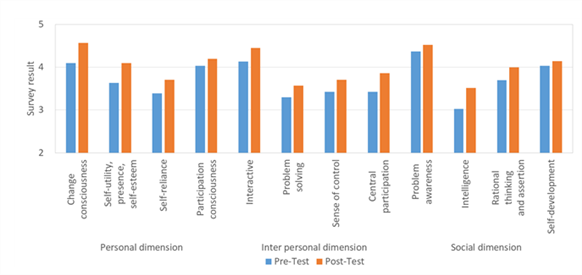
A t-test was conducted to compare before and after training between the Yanggu Jinmok fishing industry and the Hongcheon River fishery industry before and after training. As a result of the analysis, the significance probability p value of all competency subcategories was less than 0.05 and t value was greater than 1.96, and through this, it was confirmed that there is a correlation between education and performance. The personal, interpersonal, and social level of competency details showed greater results after education than before, indicating that capacity-building education contributed positively to the improvement of residents’ capacity. Table 18 and Fig. 3 shows the results of the t-test.
Table 18
t-test before and after training in the inland fishery industry
2) Comparison before and after training of coastal fishing villages
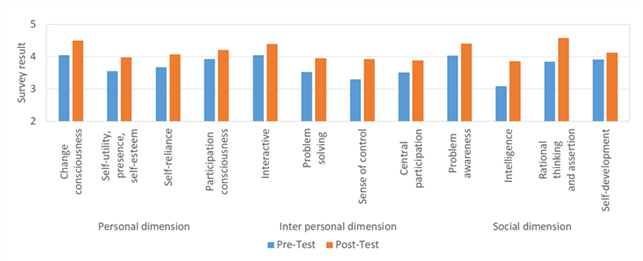
A t-test was conducted to compare before and after training between Yangyang Mulchi fishing villages and Samcheok Jangho fishing villages. As a result of the analysis, the significance probability p value of all competency subcategories was less than 0.05 and t value was greater than 1.96, and through this, it was confirmed that there is a correlation between education and performance. The personal, interpersonal, and social level of capacity details were higher than before after training, and comparing the results of these tests, it is understood that the willingness to develop in coastal fishing villages is higher than in inland fishing villages. Table 19 and Fig. 4 shows the results of the t-test.
Table 19
t-test before and after training for coastal fishing villages
3) Comparison of results before and after training of inland water fisheries and coastal fishing communities
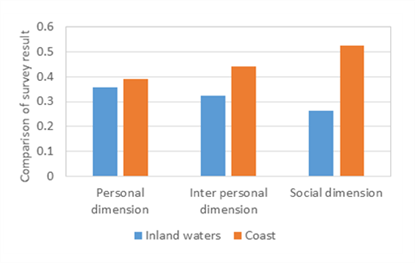
Changes in performance from capacity enhancement training and excursions in the four villages changed in a positive direction. In terms of participation in training, the willingness to develop villages was higher in coastal fishing villages than in the inland waters, and the results of training were also positive. In addition, the performance change due to training is relatively low in terms of personal performance, except for the Hongcheon fishery industry, so it is considered that additional training is needed. Table 20 shows the results of the survey before and after training, and Fig. 5 shows the results of comparing training results.
Table 20
Comparison of survey results before and after training in inland water fishing industry and coast fishing villages
Ⅴ. Conclusion
This study investigated and analyzed changes in the perception and capacity of the Gangwon Fishing Village Specialization Support Center’s project targeting 2 villages in the inland water fishing industry, 2 villages in coastal fishing villages, and a total of 4 fishing village members. It was analyzed how the training for coastal fishing village residents had the effect on the actual condition of residents’ consciousness and the change of residents’ capacities, and showed satisfactory results for the development of fishing villages.
As a result of conducting a response sample t-test by synthesizing the survey results of residents before and after education, the p value of significance probability was less than 0.05 and the t value was greater than 1.95 in each t-test. It was confirmed that it had an effect on. Changes in resident competencies were comprehensively judged through the results of the survey. Yangyang showed an increase of 0.32, and Samcheok, Yanggu, and Hongcheon showed an increase of 0.41, 0.01 and 0.66, respectively. This shows that the training for reinforcing residents’ competency in the fishing village specialization project has been successful, and as a result, residents’ perception has changed positively.
Comprehensive research results show that the outcomes of coastal fishing community training are higher than those of the inland water fisheries industry, and the recognition of development was positive, and it was investigated that it should be continued. In addition, as can be seen from the results of the overall survey, when comparing before and after training, it can be seen that the outcome of the change of residents after training rather than before training is clearly displayed.
Based on these research results, an alternative for more successful fishing village development was derived. Based on this study, a follow-up study should be followed to systematically organize the training and capacity enhancement projects required by the village by continuing to monitor the capacity enhancement projects of the residents of the fishing village and the fishing industry and categorizing them according to the characteristics of the village.