

Ⅰ. Introduction
Asphalt industries including research institutes are constantly looking for ways to improve pavement performance, increase construction efficiency, conserve resources and energy, and advance environmental stewardship (Newcomb, 2018; Angelo et al., 2008). The warm-mix asphalt (WMA) is a relatively new technology for which asphalt mixture is produced at temperature lower than conventional hot-mix asphalt (HMA) mixture. The HMA is typically produced at 150℃ to 180℃, approximately 30-40°C higher than that of WMA temperature ranges (Australian …, 2001). Thus, WMA has been gaining popularity in recent years around the world due to rising concern about global warming and stringent environmental regulations. WMA technologies can be used as a mean to decrease fossil fuel consumption and carbon emissions associated with conventional HMA production (Kim and Kim, 2014).
Since WMA is an asphalt paving technology using the mixture compacted at lower temperature than that of HMA method, implementation of WMA technology for paving remote places such as rural area can be a promising and viable option. The longer haul distance along with narrow and winding paths induces the mixture to cool down further, in addition to many limitations in pavement construction works in rural roadway. This temperature drop of HMA mixture in the haul truck can be cause of poor compaction and low quality pavement. Since the WMA mixture is compacted well at a much lower temperature, therefore, use of WMA mixture will be a satisfactory choice for rural road pavement construction (Kim and Kim, 2014).
Since the WMA mixture is produced using the aggregates heated at lower temperature than HMA mixture, there is a apprehension of whether WMA mixture would have inferior cracking resistances to the HMA concrete (Punith et al., 2012; Xiao and Amirkhanian 2010). Some studies observed that the WMA mixtures had inferior rut resistance to the HMA mixtures prepared with the same binder and aggregate (Kim et al., 2014; Park et al., 2012). This is probably resulted from some flaws existing in binder-aggregate interface due to incomplete binding on moist aggregate during production (Hong, 2012; Yeon et al., 2014).
Compared with a number of investigations of high-temperature resistance (rut) of WMA, few studies have reported the low-temperature crack and fatigue characteristics, which are the major damage mechanisms of asphalt concrete pavement (Kim et al., 2014; Yoo et al., 2011). Since asphalt becomes brittle at low temperature, HMA concretes showed brittle fracture, failing catastrophically, at low temperatures (El Hussein and Halim, 1993; Kim and El Hussein, 1995, 1997; Kim et al., 2003; Kwon, 1999).
Especially if the HMA mixture is severely oxidized by short-term aging before placing in the field, the asphalt pavement will have to be cracked prematurely due to the poor fatigue resistance of highly stiffened binder (Kim et al., 2016, 2019). Since WMA mixture is short-term aged at the temperature of 30~40oC lower than HMA mixture, the mixture is maintained less stiff condition. Therefore, the high temperature performance such as rut resistance of WMA was evaluated to be not as good as that of HMA by many researchers (Yun et al., 2014; Kim et al., 2014, 2016).
The behavior of WMA concrete under low temperatures is also in question, because the WMA may also be in a brittle state due to incomplete aggregate drying at the time of manufacturing, causing poor bonding of asphalt and aggregate. Therefore, WMA concrete might be more vulnerable to low-temperature damages (Kim et al., 2014). In brittle state, in addition to fracture, the WMA pavement may be more susceptible to cracking due to fatigue stress induced by the repeated loading of heavy vehicle wheels. Therefore, the fatigue resistance of WMA concrete is worth examining in comparison with HMA concrete. Therefore, as observed in rut testing, since the WMA concrete is assumed to have weaker resistance against dynamic wheel loading, the objective of this study was to evaluate the fatigue resistance of selected WMA concretes at a low temperature in comparison with HMA concrete.
Ⅱ. Materials and Methods
1. Materials
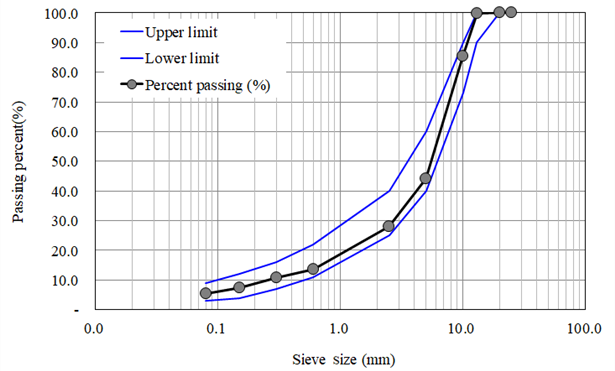
The experimental design included the use of a base asphalt (PG64-22), a WMA additive (Pexbol, abbreviated as Pe), two polymers [a mixed polymer of LDPE, EVA, and EPDM (LVM) and styrene-butadiene-styrene (SBS)] and two mix types (HMA and WMA). The Pe is a laboratory prepared porridge-type compound of two waxes and a bio-oil. The LVM is a mixed polymer consisted of a low-density polyethylene (LDPE), an ethylene vinyl acetate (EVA) and ethylene-propylene-diene- monomer (EPDM). The SBS is styrene-butadiene-styrene copolymer. The polymer-modified asphalt (PMA) binders were prepared using the polymer to improve the binder’s PG up to 76-22. The content of each binder was determined as shown in Table 1. One aggregate source, composed of granite, was used and the dense-graded aggregate gradation (MOLIT, 2017) is given in Fig. 1.
2. Mix Design and Testing
a. Binder Test
The polymer modified asphalt (PMA) binder was prepared according to predetermined polymer and warm mix additive contents using a homogenizer at 180℃ for 90 min. A PMA binder was conditioned in three levels; the original, rolling thin film oven (RTFO by KS M 2259), and pressurized aging vessel (PAV by KS F 2391:14) treatments, for testing performance grade (PG, by KS F 2389:14). Kinematic viscosity (KVS, KS M 2392) test was conducted to evaluate workability of the PMA at 135℃.
The kinematic viscosity (KVS) was measured using a Brookfield viscometer at 135℃. A binder sample was stabilized at 135℃ for 30 minutes, and then, KVS was measured at 135°C. The PG grade of each binder was measured using a dynamic shear rheometer (DSR, KS F 2393:14) and a bending beam rheometer (BBR, KS F 2390:14). In DSR test, the pass/fail (P/F) temperature, which is the highest temperature passing the critical stiffness (G*/sinδ) limit, or the lowest temperature failing the limit, was recorded for comparison of each binder. In BBR test, the P/F temperature for stiffness and m-value was also recorded for comparison of each binder.
b. Mix Design
The 13 mm dense graded HMA mixture was prepared for satisfying the specifications set forth by Korea Ministry of Land, Infrastructure and Transport (MOLIT, 2017) for surface type WC-6 HMA mixtures. The design aggregate gradations of WMA were the same as the HMA gradation. The optimum asphalt content (OAC) of HMA was first determined by mix designed and then the OAC was adjusted for WMA mixture use.
In this study, a total of 6 mixtures prepared from 1 aggregate, 2 WMA additive (including a control) and 3 polymers (including an unmodified binder). The mixture was compacted by 100 gyrations using a Superpave gyratory compactor to make a 100 mm diameter specimen.
Design criteria included following 4 properties; air voids ratio (AVR), voids filled with asphalt (VFA), voids in mineral aggregate (VMA), and the strength against deformation (SD). Specification limits were 3~5%, 65~80% and minimum of 14% for AVR, VFA and VMA, respectively. The specification limits of SD were minimum of 3.2 MPa and 4.25 MPa for unmodified (PG64-22) mixture and PMA (PG76-22) mixture, respectively.
The binder temperatures for un-modified and PMA were 160℃ and 175℃, respectively, regardless of HMA and WMA mixtures. On the other hands, aggregate temperatures for un-modified HMA and WMA were 165℃ and 135℃, respectively, those for PMA-HMA and WMA were 185℃ and 145℃, respectively.
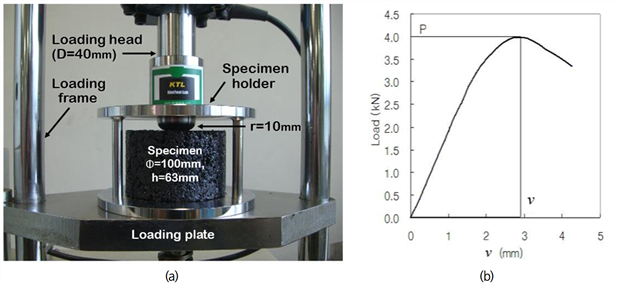
The SD, which was invented to estimate the strength against deformation at high temperatures (Kim et al., 2004, 2011), was adopted as one of the four criteria in the Korean mix-design guide (MOLIT, 2017). A static load was applied through a loading head on top of a 100 mm or 150 mm diameter specimen immersed in water bath at 60±1℃ for 30 minutes before testing, as shown in Fig. 2(a). A load-deformation curve is as shown in Fig. 2(b) and two variables, the peak load, P and the vertical deformation v at P, were read from the curve to use in SD calculation by Eq. (1).
where SD= strength against deformation (MPa), P= max load (N), v= vertical deformation (mm) at the P.
c. Fatigue Test in Three-Point Bending (3PB) Mode
Since the Poisson’s ratio of asphalt concrete at low temperatures is similar to the Poisson’s ratio level of plain concrete (Kim et al., 1999), a 3point bending (3PB by KS F 2395) mode fatigue test (KS F 278) was used for asphalt concrete at -5°C in this study. The asphalt concrete beam was conditioned for 48 hours at -5°C before testing. A slab specimen [depth (W) 70 mm×length (L) 305 mm×width (B) 305 mm], which was produced at the air void of 4±0.5%, was cut into 5 beams with the dimensions of W=70 mm×L=305 mm×B =57 mm. Among 5 beams, three in the middle were used for fatigue test (Fig. 3).
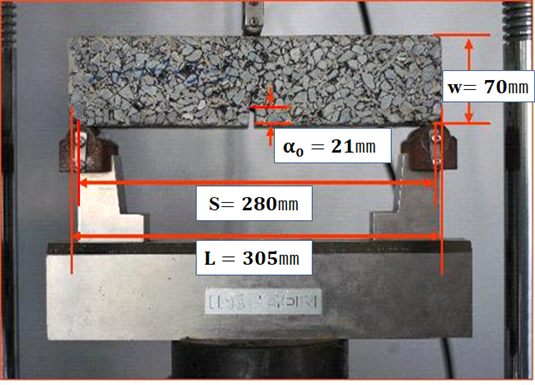
To make a simulated initial crack (ao), or a notch, to the beam depth ratio of 0.3, or ao=ao/W=0.3, a notch of approximately 21 mm in depth was created at the bottom center of the specimen using a masonry saw. Due to production variations, it was necessary to measure the depth of ao precisely from the fractured faces of each beam after testing. The span (S) of 280 mm was used to apply a load at the center of the beam at a speed of 1 Hz; 0.1 sec load application and 0.9 sec rest period in a harver-sine wave shape (Fig. 4).
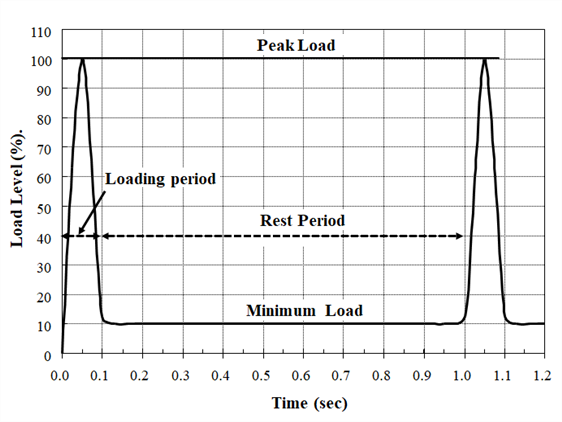
A static 3PB test was performed to obtain a flexural strength (Sf) of each material. The 50, 60 and 70% stress levels of the Sf was applied on each beam for fatigue test. The load for each stress level was calculated to use for peak load and 10% of the peak load was used for a minimum load as shown in Fig. 4.
Ⅲ. Results and Discussions
1. Binder Test
Table 2 shows WMA binders have lower kinematic viscosities than HMA binders by 14~18%. It was found that warm mix additives affected reduction of binder viscosity regardless of added polymer modifier. These reductions were results of using Pe warm-mix additives, which included a wax compound for reducing kinematic viscosity of PMA binder. The viscosity reduction ratio of unmodified binder was lower than that of PMA. PG grades of all unmodified binders were 64-22, and all PMA binders were 76-22. The low temperature grades were measured to be -22 for all HMA and WMA binders. No difference was observed in PG grade due to the use of WMA additives, even though there were some differences in critical pass/fail (P/F) temperatures in DSR and BBR results.
Table 2
Kinematic viscosity and performance grade (PG)
| Classification | Mixture | KVS (cp) | DSR P/F temp. (℃) | High PG | BBR P/F temp. (℃) | Low PG | ||||
| 135℃ | Ratio* | Orig. | RTFO | P/F | ||||||
| Un- modified | HMA | CON0 | 472 | 1 | 67.7 | 66.4 | 66.4 | 64 | -16 | -22 |
| WMA | CONW | 408 | 0.86 | 67.1 | 66.8 | 66.8 | 64 | -15 | -22 | |
| PMA | HMA | LVM0 | 1785 | 1 | 79.7 | 77.7 | 77.7 | 76 | -14 | -22 |
| SBS0 | 1519 | 1 | 80.5 | 78.2 | 78.2 | 76 | -14 | -22 | ||
| WMA | LVMW | 1458 | 0.82 | 78.2 | 77.3 | 77.3 | 76 | -13 | -22 | |
| SBSW | 1258 | 0.83 | 80.3 | 77.9 | 77.9 | 76 | -14 | -22 | ||
2. Mix Design
Table 3 shows physical properties and deformation strength (SD) for each mixture, which was prepared using the OAC ranging from 5.7% to 5.9%. Not much difference in OAC values were observed between WMA and HMA mixtures in the same material group. All specimens for HMA and WMA mixture were observed to satisfy the physical property criteria; 3~5% air void, minimum 14% of VMA, and 65~80% of VFA, set forth by the Korean guide (MOLIT, 2017). The SD, which is the average of 3 tests, of WMA mixtures, in general, was lower than HMA in the same material group. This implies that the high-temperature deformation resistance of the WMA mixture is lower than that of HMA mixture, even though the same PG level binder was used for the same material group. This result is coincide with the previous study result (Doh et al., 2007), in which the high-temperature property of WMA mixture was lower than that of the HMA mixture. All SD values were, however, passed the critical limits set forth by the Korean Ministry of Land, Infrastructure and Transport (MOLIT, 2017).
Table 3
Fundamental properties of each mixture at OAC
3. Fatigue Test
The beam was stored in an environmental chamber at –5℃ for 48 hours before being used for the repeated-loading fatigue testing in 3PB mode at the same temperature. Table 4 shows the number of cycle to failure (Nf) for each mix based on stress level. The fatigue life, which was measured by Nf until the beam was failed, was significantly decreased by the stress level increase, as shown by Nf ratio in Fig. 5.
Table 4
Fatigue test results (average value)
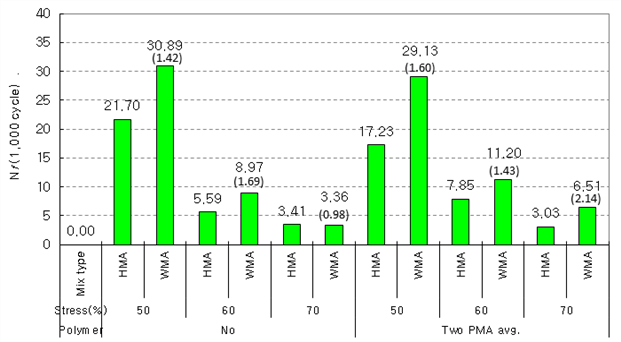
The fatigue life reduction ratio was more than 50% by every 10% stress level increase from 50% stress level. Therefore, a significant fatigue resistance reduction was observed by stress level increase for both HMA and WMA concretes. Especially for HMA SBS mixture (SBS0), the fatigue life was significantly low at 70% stress level, compared with other materials. According to this result, increasing stress level over 60% at test temperature of –5℃ was found to be critical to the results in the fatigue test for these materials.
As shown at each stress level in Figs. 5, 6, 7, and 9, the fatigue lives of WMA mixture were longer than those of HMA mixture regardless of polymer type (No: unmodified and Two PMA avg: average of LVM and SBS), except for the 70% in No. From these results, under the three stress levels, the WMA mixes were found to have stronger fatigue resistance than HMA mixes. Since two PMA average shows larger differences between WMA and HMA, it means that the WMA is more effective in PMA mixes than HMA without polymer for fatigue resistance improvement.
In comparison of two polymers, as shown in HMA PMA at 50% and 60% stress levels in Table 4, SBS0 showed somewhat longer fatigue lives than LVM0. However, in WMA PMA, the results were completely reversed. In WMA PMA at all three stress levels, LVMW showed approximately twice longer fatigue lives than SBSW. Therefore, by using WMA additive (Pe) used in this study, the LVM PMA was much more effective for improving fatigue life. This result coincided with previous works (Kim et al., 2007, Lee et al., 2008, Yoo et al., 2011) work, in which the LDPE, used in making LVM, was found to be strong material against cracking. The WMA additive might provide a chemical reaction for enhancing cracking resistance of LVM in WMA asphalt mixture.
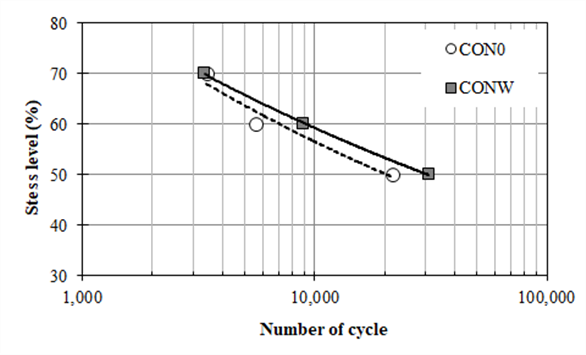
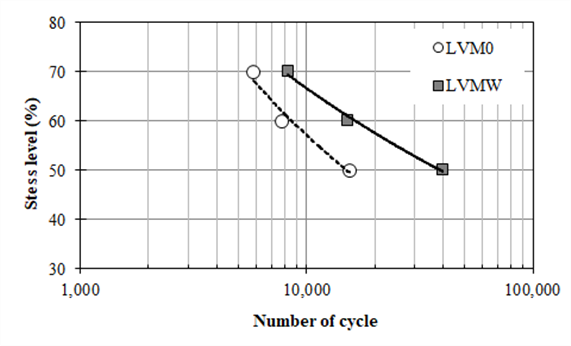
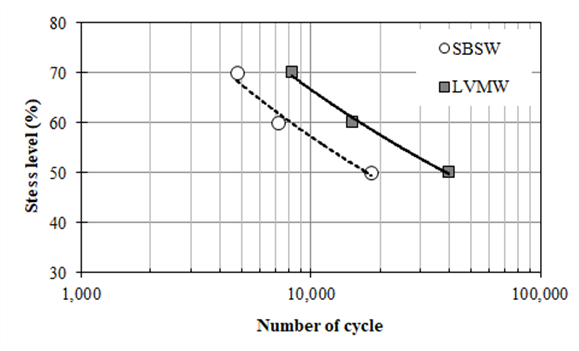
Figs 6, 7 and 8 show regression curves of the stress level versus the numbers of cycle to failure of HMA and WMA mixtures for each material. It was important to observe that, in general, the WMA mixtures showed longer fatigue lives than HMA mixtures, except the 50% stress level of HMA SBS0 mixture in Fig. 8. The LVM WMA mixture showed longest fatigue life than SBS WMA and LVM HMA mixtures, making largest difference between HMA and WMA. Unmodified mixture, however, showed the lowest difference between HMA and WMA.
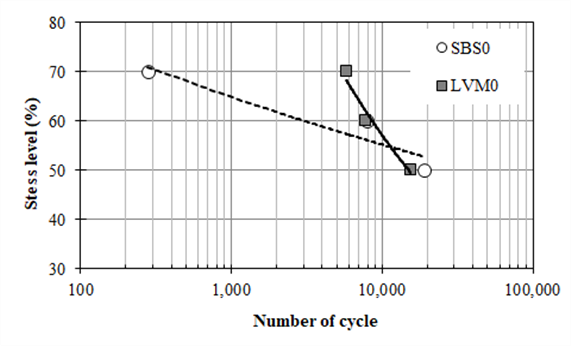
Fig. 8 shows the results of two polymer-modified HMA mixtures, which showed somewhat different trends from WMA mixture at –5℃. At 50% stress level, SBS0 showed somewhat longer fatigue life than LVM0, but at 70% stress level, LVM0 showed much longer fatigue life than SBS0. Even though it is difficult to explain why the SBS showed strong resistance to cracking at only 50% stress level, but one of the reasons is that the LVM is stronger against cracking resistance under severe stress level. Therefore, at lower level of stress, such as 50%, there was not much difference between two polymers, and the strong nature against cracking of LVM was appeared to be exposed by highly increased stress level (70-%).
Fig. 9 shows comparison of two polymer-modified WMA mixtures. The LVM-modified WMA mixture (LVMW) showed longer fatigue life than SBS-modified WMA (SBSQ) mixture. The numbers of cycle for LVMW were more than twice of those of SBSW concrete, indicating LVM being much stronger material than SBS against fatigue cracking. Since the LDPE, which was used in producing LVM, was known to be strong material against cracking (Lee et al., 2008), LVM will have to show longer fatigue life than SBS under the same stress level.
According to fatigue analyses in this study, the numbers of cycle to failure of WMA concretes were found to be greater than HMA concretes under the same stress level in most cases. This means that the WMA concretes used in this study have stronger resistance to fatigue cracking than HMA concretes at the examined low temperature. This result is in contrast to the result of high temperature property (rut) test (Yeon et al., 2014).
Since fatigue is a very complex process, determining the reason why the WMA concretes are strong against fatigue cracking is also a complex issue. However, one of the reasons probably acceptable to most asphalt engineers is a lower level of aggregate heating during production, resulting in a less short-term aging of binder. The highly oxidized binder by hot aggregate for HMA production would be much more brittle and detrimental to fatigue cracking at low temperatures (Yoo et al., 2011). However, the aggregate was cooler than binder in WMA mix, making a little oxidation progress during short-term aging period. Another reason could be due to a lower viscosity of WMA binder because of using WMA additives.
Ⅳ. Summary and Conclusions
This study evaluated fatigue resistance of warm-mix asphalt (WMA) concretes at low temperature in comparison with hot-mix asphalt (HMA) concretes. The fatigue life was measured by the dynamic loading at 1 Hz in a 3-point bending beam mode at -5℃. The conclusions drawn from this study are as follows.
The high-temperature deformation resistance of WMA concretes measured by SD was slightly lower than that of HMA, which was prepared using the same PG level binders. However, all SD values of WMA mixture were found to satisfy the minimum value of SD specification limit.
The WMA mixtures were found to have longer fatigue lives at -5℃ than HMA mixtures prepared with the same binder and aggregate under the same stress level. The most acceptable reason to asphalt engineers is the lower heating temperature which does not induce serious binder aging during production and short-term aging period, compared with HMA temperatures.
These findings lead to the conclusion that the WMA mixture is not susceptible to, but more resistible to the fatigue failure than HMA mixture at low temperature, even though they were produced at a 30~40℃ lower aggregate-heating temperature.
The fatigue life of all asphalt mixtures used in this study was significantly decreased by the stress level increase. Most of the reduction ratios were more than 50% by every 10% stress level increase from the stress level of 50%, even though there are some differences in polymer and mixture type (WMA and HMA).
This study showed that the apprehension that WMA mixture would fail faster than HMA under the same stress level was no longer necessary. However, since the results were obtained based on limited sources of material combinations (aggregate, binder, additive and polymer), further studies using more material combinations are suggested perform to reach a generalized conclusions.