

Ⅰ. Introduction
Recently, South Korea has recognized the seriousness of environmental problems that transcend national borders as it experiences direct and indirect air pollution exposure caused by yellow dust blowing from China (Kim, 2010). Among the many environmental problems in Korea, the increase in emissions of various air pollutants is unprecedented, as evidenced by the increasing number of people suffering with respiratory diseases, particularly in urban areas. Environmental pollution has been attributed to economic development and industrialization, and a large portion of this pollution is caused by harmful gases, such as those emitted from factories and automobiles (Kim, 2000). Among the many pollutants, nitrogen oxides (NOx) are responsible for a large portion of air pollution and have been linked to various respiratory issues, as well as photochemical smog and acid rain (Kim et al., 2001). In Europe, photocatalyst materials are mixed with cement and applied to building walls, sidewalk blocks, and plasters to remove NOx (Youn et al., 2013), and in Japan, photoreactive materials are applied to tile coatings for pollution control (Youn et al., 2013). In Korea, there has been great interest in photocatalyst development as an alternative construction material to the one for creating more environmentally friendly living spaces. Some studies investigated recycling the stone sludge generated during surface polishing processes and mixing them with photocatalysts for sidewalk block production (Jung et al., 2015). And others evaluated the air purification properties of sidewalk blocks with the mixing ratio of concrete and the number of photocatalyst coatings (Jung et al., 2015). For example, concrete sidewalk block to which a photocatalyst was applied exhibited 70% air purification performance initially and 68% air purification performance under accelerated weathering conditions (Jung et al., 2015). Another study evaluated self-purification and removal of toxic gases by surface- impregnated concrete after spraying a photocatalyst on the concrete surface; the purification performance inherent in the photocatalyst was maintained, even after application to the concrete (Kim et al., 2018). Thus, the application of photocatalysts to building materials, such as concrete, should be effective in the removal of organic pollutants; additionally, this approach can treat high concentrations of air pollutants and does not require a special installation site.
The study examined NOx removal by air purification concrete blocks treated with titanium dioxide (TiO₂) under the conditions of automobile/agricultural machine, in which NOx was present in the exhaust gas.
In the previous study, a concrete block was manufactured by adding TiO₂ to the concrete mix to evaluate the NOx removal effect. However, in this study, the NOx removal effect was evaluated by applying the method of spraying TiO₂ on the concrete block surface in consideration of maintenance.
Ⅱ. Materials and Methods
1. Materials
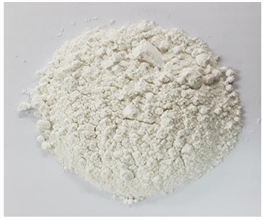
This study used type I ordinary Portland cement; Table 1 lists the physical properties. The fine aggregate was silica sand, with a density (g/㎣) of 2.65. The principle of the photocatalytic reaction is that electrons in the photocatalyst material, such as titanium dioxide (TiO₂), are excited to higher energy states under ultraviolet (UV) light exposure (for TiO₂, UV light having a wavelength of about 400 nm or less). This creates electrons (e⁻) and holes (h⁺, i.e., the absence of an electron) (Kim et al., 2014). The electrons diffuse to the surface and react with oxygen or moisture in the atmosphere to produce reactive oxygen species with strong oxidizing power. Chemicals or superoxide ions generated in this way remove various pollutants and create anti-fouling and antibacterial effects, while removing NOx from automobile exhaust gas. TiO₂ can be classified into three crystalline forms: (1) anatase, (2) rutile, and (3) brookite types. The rutile type is mostly used as a coating, paint, or pigment, due to its weather resistance, hiding power, and brightness (white) (Kim et al., 2014). The anatase type is often used as a photocatalyst, as it is easy to decompose or crystallize; however, it is not used for products requiring weatherproofing or pure white coatings. Additionally, the anatase type is less expensive than the rutile type (Kim, 2010). In this study, given that white luminance is not required and the unit price is considered in production, we used anatase-type TiO₂ in the development of our air purification block products to reduce costs (Fig. 2). Table 2 and Fig. 2 present the characteristics and form of TiO₂.
Table 1
Properties of cement
| Fineness (㎠/g) | Density (g/㎣) | Stability (%) | Setting time (min) | |
| Initial | Final | |||
| 3,200 | 3.15 | 0.02 | 220 | 400 |
Table 2
Characteristics of titanium dioxide (TiO2)
| Type | Content (%) | Shape | Melting point (℃) | Molecular weight (g/mol) | Density (g/㎣) |
| Anatase | 98 | Solid (white) | 1850 | 79.88 | 3.8–4.3 |
2. Mix proportions
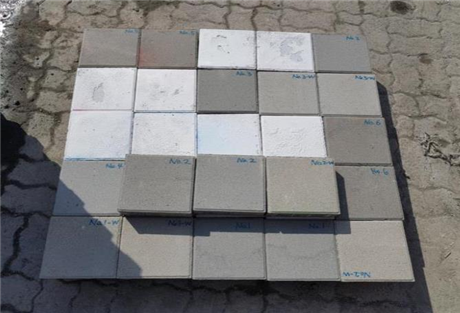
In this study, the effect of the addition rate of TiO₂ was evaluated based on the mix proportion at the surface finish layer of the sidewalk block. TiO₂ was added for cement at weights of 0, 5, and 10% to evaluate the influence of the addition of TiO₂. Table 3 lists the mix proportions applied in this study. The concrete block mix No. 1 had 0% TiO₂. mix No. 2 and No. 3 involved incorporating TiO₂ into the concrete mixture (fixing method 1) at 5% and 10%, respectively, with general/normal surface treatment or washing of the surface. Mix No. 4 and No. 5 involved TiO₂ incorporation through a diluted spray treatment (fixing method 2).
3. Fixation method of titanium dioxide (TiO2)
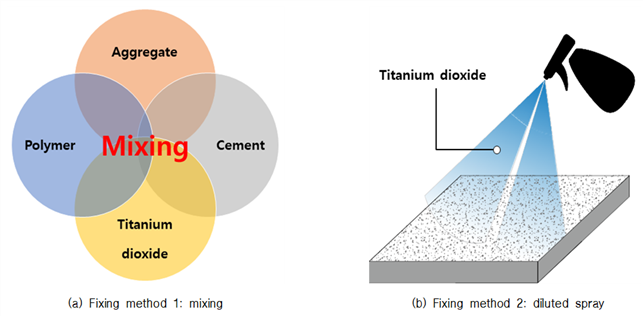
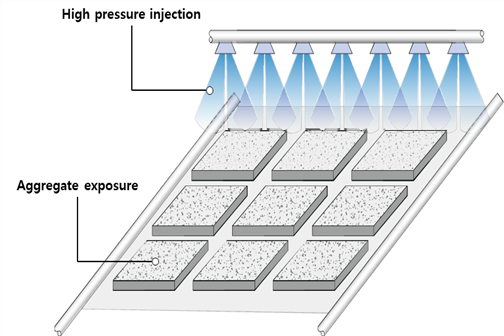
Because differences in the TiO₂ mixing rate and fixation technique may lead to differences in the removal of NOx, we used two methods to produce specimens, as shown in Figure 2. The first (fixing method 1) involved drying the cement and fine aggregate for 1 min and then mixing in the TiO₂ additive. Here, simultaneous mixing of TiO₂ resulted in the removal of exhaust gas through a photoreaction that occurred on the surface of the air purification block. The second (fixing method 2) involved diluting TiO₂ with distilled water or alcohol and then spraying the liquid mixture onto the block surface. Thus, from the two methods, we obtained one specimen type in which the cement mixture incorporated the TiO₂ during mixing and a second type in which the block surface was coated with a diluted TiO₂ solution. Fig. 3 presents the surface treatment method. Fig. 4 presents the as-fabricated specimens.
4. Test methods
(1) Compressive Strength
Compressive strength tests were performed by the KS L 5105. Six specimens were fabricated with a size of 50×50×50 mm. Tests were performed after 28 days of curing.
(2) Nitrogen oxide removal test
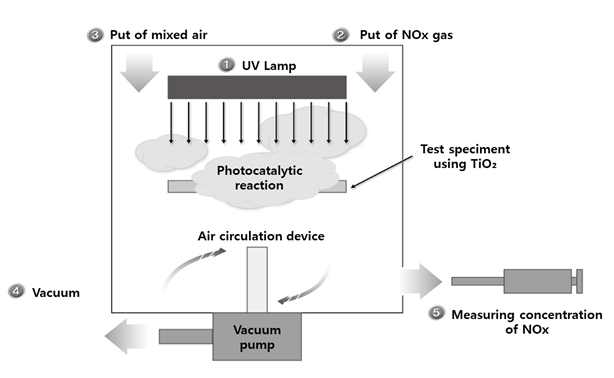
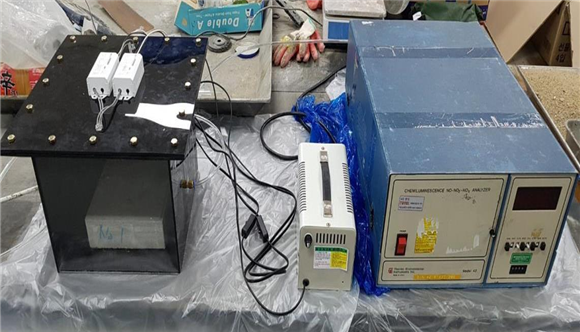
Although NOx was the main consideration in this study, Korea currently has no standardized procedures for evaluating exhaust gas removal. In domestic studies, performance evaluations of the NOx elimination effect have mainly been conducted using pollutant reactors. This study carried out our tests according to KS L ISO 22197-1 “Fine ceramics (advanced ceramics, advanced technical ceramics)-Test method for air-purification performance of semiconducting photocatalytic materials-Part 1: Removal of nitric oxide,” which uses a NOx pollutant reactor. The pollutant reactor in which the specimen was exposed to the test gas was manufactured as a box shape with a size of 310×310×265 mm, to facilitate the attachment of UV-A and blacklight blue lamps for photoreaction. The test gas NOx was introduced at a concentration of 1.4 ppm. The concentration of NOx gas discharged through the NOx meter at the outlet was measured for 60 min. Fig. 5 and Fig. 6 are present schematic diagrams of the pollutant reactor and the NOx removal test, respectively (Park et al., 2001).
Ⅲ. Test results
1. Compressive Strength
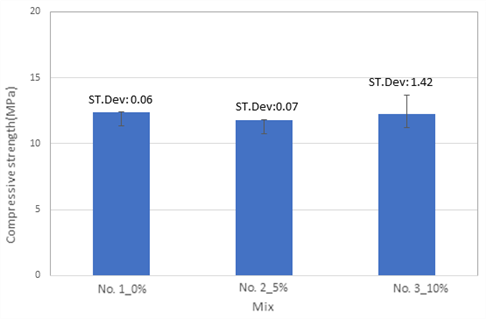
Tests revealed that compressive strength values were 12.37 MPa for sample No. 1 with a 0% TiO₂ mixing ratio, 11.7 MPa for sample No. 2 with a 5% TiO₂ mixing ratio, and 12.24 MPa for sample No. 3 with a 10% TiO₂ mixing ratio (Fig. 7). Compared to the mix without TiO₂, the mixes with 5% and 10% TiO₂ mixing ratio provided 4.93% and 1.05% reductions in compressive strength, respectively. As a result of the test, the strength decreased slightly, although the change was not significant. Therefore, it was concluded that the addition of TiO₂ did not significantly affect the compressive strength.
2. Removal efficiency of nitrogen oxides
The test gas was introduced at a concentration of 1.4 ppm, and the concentrations of NO1, NO₂, and NOx gases discharged for each mix were measured for 60 min. Figs. 8–10 shows the changes in the NO₁, NO2, and NOx concentrations for up to 60 s of elapsed time for 0%, 5%, and 10% TiO₂ under simultaneous mixing with respect to the surface treatment (general/normal versus washing). The NO1, NO₂, and NOx removal efficiencies of mix No. 1 with a TiO₂ mixing ratio of 0% were 0.56%, 0.61%, and 0.55%, respectively, and there was no change in the gas concentration after 60 min. Thus, these results show no removal effect, as there was no mixing of TiO₂ in this mix (Fig. 8).
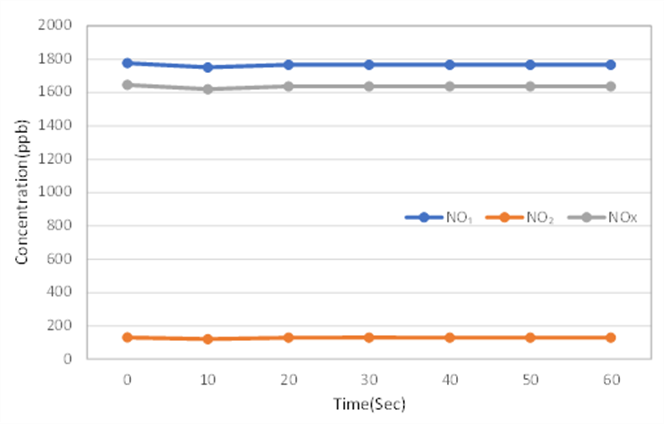
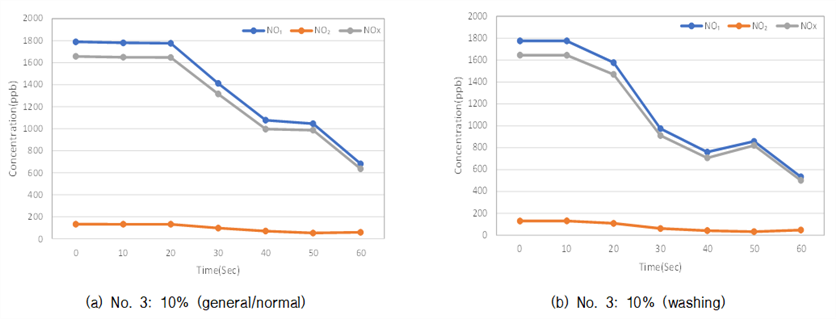
Fig. 10
Results of the NOx removal test for mix No. 3 with 10% TiO2 prepared with a general/normal surface treatment or washing surface treatment
The NO₁, NO₂, and NOx removal efficiencies of the No. 2 mix with a TiO₂ mixing ratio of 5% under normal surface treatment were 58.79%, 60.57%, and 57.21%, respectively, and 62.58%, 61.72%, and 61.85%, respectively, for sample No. 2 with a washed surface. Shown as Fig. 9, the NO1, NO2, and NOx concentrations displayed decrease trend in the case of No. 2 with the both normal and washing surface treatments over 60 seconds. And rapid decrease trends were observed after 10 second for normal surface treatment case (Fig. 9(a)) and after 20 second for washing surface treatment case (Fig. 9(b)).
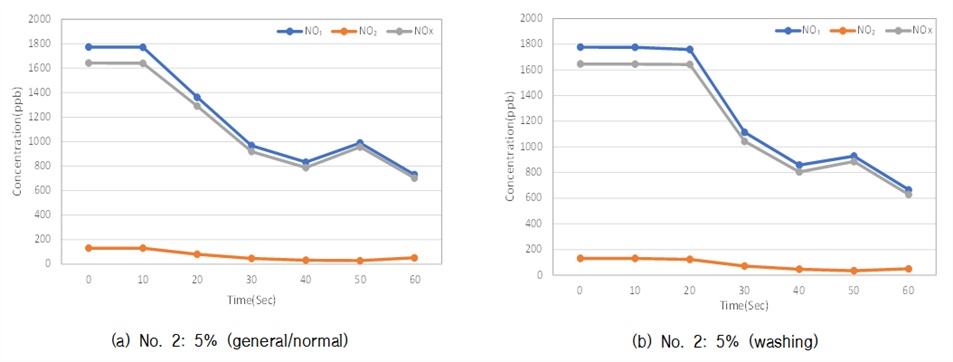
Fig. 9
Results of the NOx removal test for the No. 2 mix (5% TiO2) prepared using general/normal and washing surface treatments
The NO₁, NO₂, and NOx removal efficiencies of the No. 3 mix with 10% TiO₂ were 61.99%, 56.19%, and 61.68%, respectively, for the general/normal surface treatment and 69.93%, 63.40%, and 69.51%, respectively for the washing surface treatment. Changes in NO₁, NO₂, and NOx concentrations discharged over a 60-min period for sample No. 3 (10% TiO₂) were reduced after 20 s for the general/normal surface treatment, compared with 10 s for samples whose surfaces had been washed.
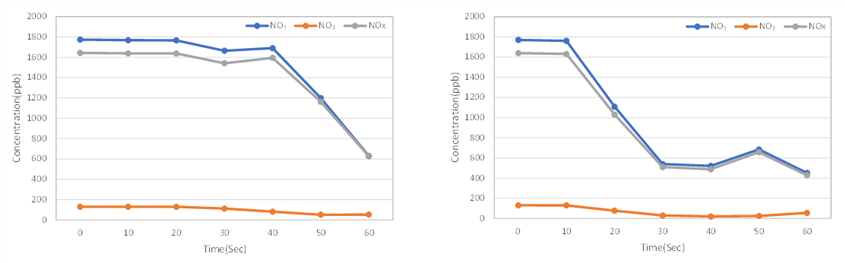
The NO₁, NO₂, and NOx removal efficiencies for the No. 4 mix with a TiO₂ mixing rate of 5% were 64.51%, 58.81%, and 61.86%, respectively. The concentrations of NO₁, NO₂, and NOx discharged for 60 min from the No. 4 sample did not change greatly during the first 20 s, but then decreased rapidly after 40 s (Fig. 11).
The NO₁, NO₂, and NOx removal efficiencies for the No. 5 mix with 10% TiO₂ applied as a diluted spray were 74.49%, 57.10%, and 73.84%, respectively. The concentrations of NO₁, NO₂, and NOx discharged for 60 min in the No. 5 mix decreased rapidly after 10 s (Fig. 12).
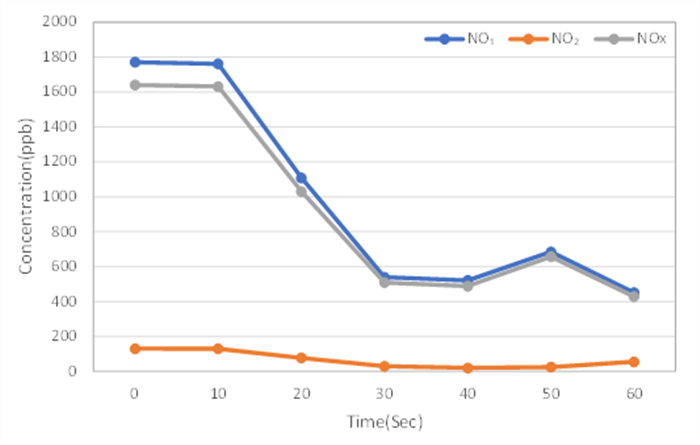
The NOx concentration changes over measurement time showed that the values of NO₁ and NOx increased slightly form 40 to 50 seconds (Figs. 8∼12). These are an error form concentration measurements at the inlet and outlet of the NOx removal efficiency test equipment, however the error did not significantly affect the trend of the overall removal efficiency.
This study also examined the NOx removal efficiency according to the percentage of TiO₂ additive, the surface treatment method, and the fabrication/fixing method; NO₁, NO₂, and NOx results were averaged for each mix. The average removal efficiency for mix No. 1 with a TiO₂ mixing ratio of 0% was 0.57%. The average removal efficiencies of NOx for mix No. 2 (5% TiO₂) were 58.86% and 62.05%, with general/normal and washing surface treatments, respectively; for the No. 3 mix (10% TiO₂), the average removal efficiencies were 59.94% and 67.61%, respectively (Fig. 13).
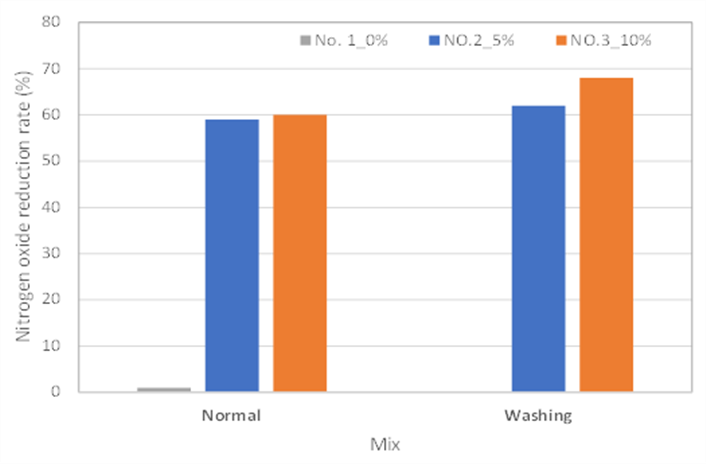
Fig. 13
NOx removal efficiency of fixing method 1 (mixing) for mixs No. 2 (5% TiO2) and No. 3 (10% TiO2) with normal surface treatment and washing surface treatment
For the No. 4 (5% TiO₂) and No. 5 (10% TiO₂) mixs involving a diluted spray of TiO₂ onto the block surface, the average NOx removal efficiency was 61.72% and 68.48%, respectively (Fig. 14).
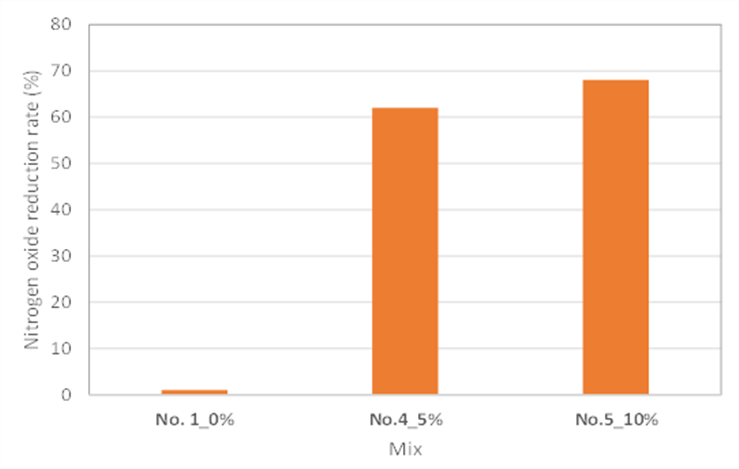
Fig. 14
NOx removal efficiency from 5% (No. 4) and 10% (No. 5) TiO2 samples prepared using the diluted spray method
The NOx removal efficiency was high, up to 58% or more on average; this was due to the rapid progression of the reaction. The size of the pollutant reactor was small, and the concentration of NOx gas was injected in small amounts at 1.4 ppm. Accordingly, in terms of the removal efficiency of NOx, samples with a mixing ratio of 10% (No. 3 and 5) were superior to samples with a TiO₂ mixing ratio of 5% (No. 2 and 4). This indicates that a higher mixing ratio of TiO₂ yields a better NOx removal effect. Based on the efficiency of NOx, mixing (washing) and diluted spray are appropriate treatment for the fixing method of TiO₂. And comparing these methods, the diluted spray method can be used in terms of NOx removal efficiency (Table 4).
Table 4
NOx removal efficiency according tho the fixation method of TiO2
Ⅳ. Conclusions
This study evaluated the effect of TiO₂ on the removal of NOx from exhaust gas by air purification concrete blocks. The compressive strength was assessed according to the mixing rate of TiO₂, and the removal efficiency of NOx was assessed according to the mixing ratio and fixation method of TiO₂. The results are as follows.
Compared to the mix not applying TiO₂, compressive strengths in the mixs with 5% and 10% TiO₂ were reduced by 4.93% and 1.05%, respectively. However, the change in compressive strength was not large. Therefore, the addition of TiO₂ did not significantly affect to the compressive strength.
In this study, it was observed that the NOx removal efficiency was improved as the addition rate of TiO₂ increases. And, the mixing (washing) and diluted spray methods provided better NOx removal efficiency, compared to the one by the fixing method (normal). Therefore, the diluted spray method can be employed in the manufacture of air purification concrete blocks.
The study did not evaluate the change of NOx removal efficiency for long-term period. In future study, there is a need to evaluate the NOx removal efficiency for long-term period with the TiO₂ addition rate. Also, the addition rate of TiO₂ were applied up to 10% of cement weight, though, there is a need to examine if it is cost-effective method to apply more than 10% of TiO₂.