

Ⅰ. Introduction
The most popular road-paving material is asphalt concrete and approximately 90% of roadways (highways, streets and low-volume roads including rural roads) pavements are paved with the asphalt concrete in the world (NAPA and EAPA, 2009). The typical paving method is to use the asphalt concrete (as-con) mixture at hot-temperature. The warm-mix asphalt (WMA) is an asphalt concrete mixture produced at the temperature lower than the conventional hot-mix asphalt (HMA). The typical working temperature of WMA is at around 130oC, compared to the working temperature of 160oC or higher for HMA (AAPA, 2001; Choi et al., 2019).
The ‘World of Asphalt 2004’ featured a demonstration project on WMA, and since then, the major WMA additive companies have carried out several demonstration projects in the United States. The WMA has been gaining popularity in recent years around the country in Korea (Busan city, 2014) and in the world. Rising air pollution issues, global warming, energy-saving, and more stringent environmental regulations are the primary reasons for using WMA (Angelo et al., 2008). The WMA can be means of decreasing energy consumption and polluted gas emissions associated with conventional HMA production. Since the working temperature of asphalt concrete material can be reduced by 30oC on average, the WMA was proved to be an effective measure for energy saving and environmental issues (Angelo et al., 2008; Prowell and Hurrley, 2008; Newcomb, 2007).
The implementation of WMA can be a viable option for paving operations for remote place road in rural areas, not only due to environmental issues, but also due to lower working temperatures. Because of longer haul distance along with narrow and winding paths in many rural roads, a temperature drop of the paving mixture is inevitable when HMA is used. The cooled-down HMA mixture is a cause of poor compaction resulting in the low-quality pavement (Linden et al., 1989; Lee et al., 2012). In addition to the temperature drop problem, since many rural roads are one-way narrow paths, there are many limitations for paving operation using heavy-and-large equipments.
Therefore, the WMA concrete is appeared to be a good choice for rural road pavement construction, because the cooled-down mixture can be still compacted to meet the quality requirement (MLIT, 2017). However, even though the WMA is appeared to be a viable option for paving rural roadways, the WMA concrete quality level should be investigated before implementation. If the lower quality standard is applied for rural road pavement due to lower volume of traffic on it, the rural-road pavement may be susceptible to pothole and weathering, compared to the normal pavement, due to lack of official maintenance practices (Saarenketo and Aho, 2005).
The pavement for any normal traffic road is constructed on the proper foundation by layer thickness design using the asphalt concrete prepared by proper mix design (Kim and Yeon, 1992; MLIT, 2017; ScDOT, 2007). In addition, the pavement thickness design guide has not been established and the quality control for paved asphalt concrete density may not be applied during construction for rural road pavement (Na et al., 2018).
Therefore, if the rural road pavement is constructed using WMA concrete, the strength of the WMA should be strong enough to sustain environmental effects, including moisture damage and weathering, in addition to traffic loading on the pavement. This study is designed to evaluate the engineering properties of WMA binders and WMA concretes (including moisture resistance), which were prepared to use for rural road pavement. The objective of this study is to evaluate and suggest the proper fundamental property level of the WMA concrete for rural road pavement.
Ⅱ. Materials and Methods
1. Materials
In this study, normal (unmodified) WMA concrete quality was investigated for application to the rural road pavement. Two maximum sizes (13 and 19 ㎜) of granite-based aggregates were used for dense-graded surface course mixtures. The screenings and limestone powder were used as the fine aggregate and mineral filler, respectively, for asphalt concrete mixture. Three binders were prepared using two WMA additives and a base asphalt (AP) which shows the performance grade (PG) of 64-22 (Asphalt Institute, 2002).
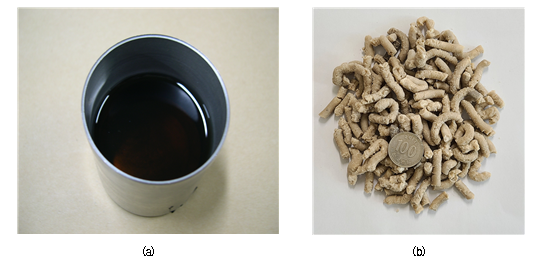
The two WMA additives (Fig. 1) include Evotherm (EV), the emulsion type additive, and K-Pearl (KP), the wax and oil-based pellet-type additive were used for producing WMA mixtures. EV was melted into the heated asphalt at 160oC and blended with a spatula for 3-5 minutes before use. However, KP was added to the mixer just before mixing with asphalt and aggregates in the mixing bowl. Designation, description and content by weight of each additive are shown in Table 1.
Table 1
Binder designation and description
| Type | Designation | Description | Note |
| HMA | AP (control) | AP (PG 64-22) | Without additive and modifier |
| WMA | EV | AP + EV (0.5wt% of binder) | Chemical emulsion type |
| KP | AP + KP (1.7wt% of binder) | Wax base pellet type |
Since the rural road pavement is deteriorated due to environmental damage, in addition to traffic loading, the moisture resistance after freezing-and-thawing (F-T) was evaluated by tensile strength ratio (TSR). Since moisture resistance can be enhanced by using hydrated lime (Kim, 2015; Kim et al., 2019; Lesueur, 2010), a hydrated lime (HL) was added (by 1 wt. % of total mix) to a WMA mixture for moisture resistance test. Total 6 mixtures (2 aggregates × 1 gradations × 3 binders) were produced for the surface course.
2. Binder Test
The kinematic viscosity (KS F 2392) of the asphalt binder sample was measured in two different temperatures, 135oC and 115oC, using a rotational viscometer. The PG grade of each binder was measured using the dynamic shear rheometer (DSR) and bending beam rheometer (BBR). The binder stiffness (G*/sinδ) was measured from 64oC, which is high-temperature PG grade of base asphalt, up to the temperature where binder fails to pass the limit. Using BBR, beam stiffness and m-value were measured to estimate the low temperature PG of binder (Asphalt Institute, 2002).
3. Mix-Design
All WMA mixtures were short-term aged for 2 hours in a 130oC oven, while HMA mixture was short-term aged for 1 hour in a 160oC oven. For mix-design, the specimen was compacted by 75 gyrations using a Superpave gyratory compactor. The optimum asphalt content (OAC) of HMA was determined using the specification limits of four properties; the air-void ratio, void in mineral aggregate (VMA), voids filled with asphalt (VFA) and the deformation strength (SD). The OAC was selected at the air-void ratio of 4%, as long as VFA and VMA satisfied specification limits by the Korean Guide (MLIT, 2017). Once the OAC of HMA was determined, the same OAC was used for the WMA mix with a minor adjustment by checking physical properties.
4. Deformation Strength (SD)
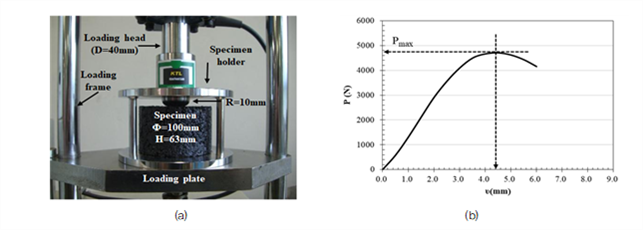
The SDis the strength property representing resistance against deformation at high-temperature (60oC) under a static-mode loading applied on top center of a briquette specimen of asphalt concrete (Doh et al., 2007; Kim et al., 2004(a); Kim et al., 2011). The specimen is soaked in 60oC water for 30 minutes and then placed in the specimen holder for measuring SD, as shown in Fig. 2(a). Static loading is applied at the speed of 30 ㎜/min through the loading head (40 ㎜ diameter with a 10 ㎜ radius (r) of round cut at the bottom edge) until failure, as shown in Fig. 2(b) (Baek et al., 2009; Park et al., 2008). From the load (P) and deformation (v) curve of the test, designated as “Kim Test,” the peak load, P and the vertical deformation, v at P were read and used in Eq. (1) for SD calculation (Kim et al., 2004(a)).
where SD is the strength against deformation (MPa), P is the maximum load (N), and v is the vertical deformation (㎜) at maximum load.
Since the SD shows a good correlation with rut characteristics of dense grade asphalt concrete, it was adopted as a standard criterion in the Korean asphalt mix-design guide (Kim et al., 2006; Kim et al., 2011), in which the specific criteria of strength level are given. The criteria for SD in Korean guide (MLIT, 2017) are SD ≥ 3.20 MPa and SD ≥ 4.25 MPa for the 2nd class road and 1st class highway pavements, respectively. Detailed Kim Test procedures are given elsewhere (Doh et al., 2007; Kim et al., 2004(a); 2004(b); 2011; MLIT, 2017).
5. Wheel Tracking Test
It is a widely held hypothesis that the wheel tracking (WT), used in much research, gives a reasonable prediction of rutting in the field (Kim et al., 2011, 2018). The rut depth data collected from wheel paths under the simulated conditions are assumed to indicate the rut characteristics of the asphalt concrete in the field (Brown and Gibb, 1996). The data used in this study were from a wheel tracker that consisted of a steel wheel (200 ㎜ in diameter and 50 ㎜ in width) rolling on top of a slab specimen on a base plate moving with a 200 ㎜ stroke back and forth. A WT test was performed for 7,200 passes at 60oC at a speed of 40 cycle/min for 90 minutes, with a pressure of 689.4 kPa (100 psi). The final rut depth data at 3,600 cycles were used for analysis.
6. Indirect Tensile Strength Test and Tensile Strength Ratio
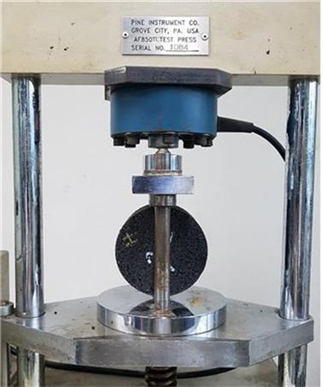
The tensile strength (ST) of asphalt concrete was measured by indirect tension test (KS F 2382) at 25oC on 100 ㎜ diameter, 63 ㎜ thickness specimen. A static loading is applied at the speed of 50 ㎜/min through loading strips on top and bottom of specimen (Fig. 3). The ST was calculated using Eq. (2).
where ST is the indirect tensile strength (kPa), P is the peak load (N), D is the specimen diameter (㎜), and t is the specimen thickness (㎜).
In this study, to examine durability of asphalt concrete for rural road pavement, the tensile strength ratio (TSR) was evaluated after freezing-and-thawing (F-T) conditioning. Since the lower strength asphalt concrete shows, in general, lower durability during in service in the pavement, a WMA mixture, which showed the lower strength values ( and
and  ) on average, was only selected to evaluate TSR. The specimens (diameter of 100 ㎜, heigh of 63 ㎜) were prepared with air void of 7±1% for a F-T cycle, for which a freezing at -18oC for 16 hours and then submerging at 60oC water for 24 hours for wet-conditioning by AASHTO T 283 (2014). The specimen, picked out from 60oC water, was submerged into the 25oC water bath for two hours before ST testing. The dry specimen was kept in an environmental chamber controlled at 25oC for 48 hours. Three specimens were used for each conditioning and TSR was calculated by Eq. (3) using the average value for each condition.
where TSR (%) is the tensile strength ratio, STwet is the indirect tensile strength (kPa) of wet-conditioned specimen, and STdryis the indirect tensile strength (kPa) of dry specimen.
Ⅲ. Results and Discussions
1. Evaluation of Asphalt Binder
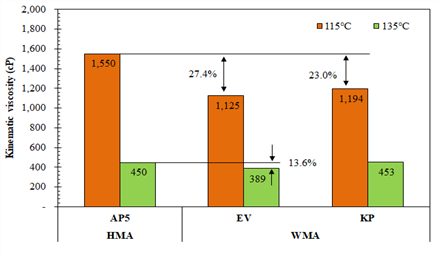
Table 2 shows binder test results. WMA binders, which showed PG 64-22, showed lower kinematic viscosity at 135and 115oC than AP (base asphalt). The compaction temperatures of HMA and WMA are considered approximately 135 and 115oC, respectively. Those temperatures are the mixture temperatures, which were cooled down, when compacted by roller after wide spreading by the paver. Therefore, kinematic viscosity of two binders were tested at 135 and 115oC.
Table 2
Test results of kinematic viscosity and PG for various binders
| Type | Designation | Kin. viscosity (cP) | PG failure temp. (oC) | PG | ||
| 115oC | 135oC | High | Low | |||
| HMA | AP | 1,550 | 450 | 68.2 | -15 | 64-22 |
| WMA | EV | 1,125 | 389 | 69.7 | -14 | 64-22 |
| KP | 1,194 | 453 | 66.4 | -16 | 64-22 | |
Comparing kinematic viscosity of HMA and WMA binders, as shown in Fig. 4, the WMA binder using EV were 27.4% and 13.6% lower than HMA binders at 115oC and 135oC, respectively. The WMA binder using KP was 23.0% lower than HMA binder at 115oC, but similar to each other at 135oC. The test result indicated that the WMA binders used in this study will be more effective for compaction at lower temperature, i.e., at 115oC, than the HMA binder.
All binders of HMA and WMA show similar failure temperature from 66 to 69oC. Therefore, WMA binders were not observed to be inferior to the HMA binders, even though WMA additives, which might cause softening of the binder at high service temperature, were contained. The low temperature grade was all measured to be -22oC, even though there were some differences in failure temperature to pass the maximum stiffness and minimum m-value.
2. Evaluation of Asphalt Concrete
Table 3 shows physical properties measured from the specimens prepared using the optimum asphalt content (OAC) and Table 4 shows three properties of HMA and WMA concretes. The values of SD ≥ 3.20 MPa, WT rut depth ≤ 5 ㎜ and ST ≥600 kPa are, in general, considered an acceptable level of engineering properties of asphalt concrete pavement for the 2nd class road pavement (ScDOT, 2007). The 2nd class road includes most of the two-lane roadways with daily traffic volume less than 1,000 ESAL (equivalent single axle loading). Therefore, WT rut depth of 5 ㎜ and ST of 600 kPa were considered as guidelines of WMA concrete for rural roads.
Table 3
Mix-designed physical properties of various mixtures
Table 4
Test results of asphalt concrete properties
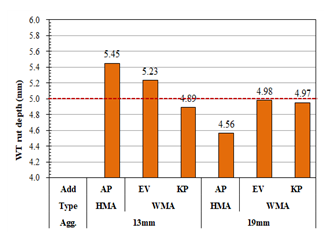
All the HMA and WMA concretes satisfied the limits of SD and ST, although one HMA and one WMA mixes were slightly over the WT limit. However, those values are still very close to the 5 ㎜, which can be considered acceptable for rural roads pavement. Figs. 5~7 illustrated individual values of each test for more detailed analyses.
In Fig. 5, SD values of 19 ㎜ showed higher, on average, than those of 13 ㎜. In case of 13 ㎜, WMA concretes showed higher SD, but for the case of 19 ㎜, WMA conversely showed lower SD values. However, still all values satisfied the 3.2 MPa limit, indicating that WMA concretes have high enough strength for 2nd class roadways and rural roads. In general, the asphalt concrete made of the larger aggregate shows stronger resistance against rutting. But according to this result, the use of asphalt concrete with 13 ㎜ aggregate was found to be strong enough for rural road pavement.
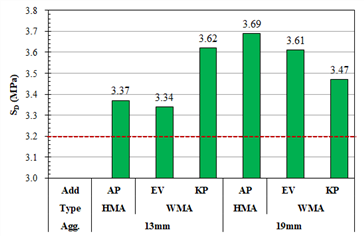
The short-term aging temperatures of WMA and HMA were 130oC and 160oC, respectively. It is possible to state that the WMA additive performed properly at WMA temperatures (130oC) for mixing. Therefore, the WMA concrete appeared to be compacted properly at 30oC lower than the HMA temperature. This will be a good indication that the WMA will be workable properly at a cooled-down temperature for a rural working environment.
Fig. 6 shows wheel tracking test results. In general, as expected from SD results, WT rut depths of 13 ㎜ were higher than those of 19 ㎜, indicating 19 ㎜ being better in rut resistance. However, it was difficult to see a pattern of difference between WMA and HMA concretes. The limit of 5 ㎜ rut depth is the guideline for the 2nd class roadway pavement (ScDOT, 2007), therefore, a somewhat higher limit, such as 6 ㎜ or less, might be allowable for rural road pavement. According to this test result, even though some mixes showed a little higher than 5 ㎜ rut depth, the rut resistance of WMA concrete with 13 ㎜ aggregate seems to be strong enough for rural road pavement.
The tensile strength (ST) was measured at 25oC and illustrated in Fig. 7. According to ST, WMA concretes revealed similar or somewhat higher strengths than HMA concretes. Therefore, in case of tensile strength, an ambient temperature property, basically no difference was observed between HMA and WMA concretes prepared using the same PG grade binders. Therefore, the normal (unmodified) WMA concretes seemed to be strong enough for rural road pavement because the ambient (25oC) and high (60oC) temperature performance were good enough when they were compared with those of HMA concretes.
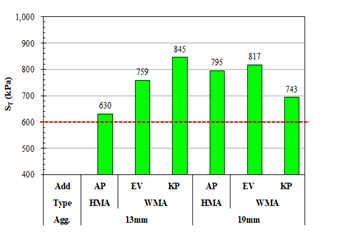
Table 5 shows test results of tensile strength ratio (TSR) of rural road asphalt concretes. Since a HMA and a WMA were below 75%, which is the limit value of TSR by AASHTO (2014), those mixes were not satisfactory without hydrated lime (HL). However, by adding HL by 1 wt % of total mix, the TSR levels for both WMA mixes were improved to be superior levels, i.e., 97% or higher. If an asphalt concrete shows high TSR level, the pavement serviceability life will be extended with great durability under freezing weather condition. Therefore, it would be better to used HL in WMA mixtures for rural road pavement.
3. Correlation Analysis
The SD is essential property used as one of the mix-design criteria of asphalt concrete in Korea mix-design guide (MLIT, 2017). Therefore, many studies evaluated the correlation of other properties with SD for HMA concretes (Lee et al., 2004; Kim et al., 2004(a); 2004(b)). This study examined correlation of WT rut depth and ST with SD using WMA concrete data only (Figs. 8 and 9).
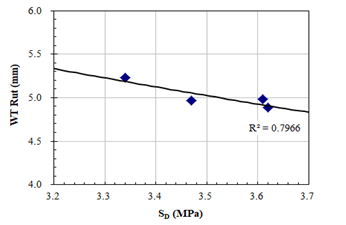
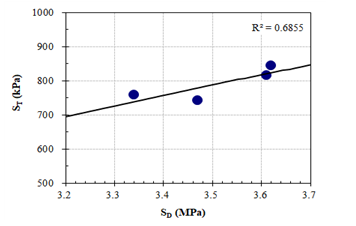
The WT rut depth was reduced by SD increase with R2 ≒ 0.80, indicating that the asphalt concrete showing higher SD would be stronger against rutting. The ST was increased by SD increase with R2 ≒ 0.70, indicating that the asphalt concrete with higher SD would be stronger against tensile stress. Since ST is used as an index of cracking resistance for asphalt pavement, the asphalt concrete with higher SD will be considered tougher against cracking.
According to these correlation analyses, the SD, the most fundamental property measured during the mix-design stage, can be used as a criterion of WMA concrete for rural road pavement. The regression curve between WT rut depth and SD in Fig. 8 showed that the WT rut depth of 5.3 ㎜ at SD of 3.2 MPa was shown to decrease with SD increase. Using the regression model in Fig. 8, the WT rut depth of 5.3 ㎜ can be estimated by SD = 3.2 MPa. By getting rid of the decimal point from 5.3 ㎜ for practical use, therefore, the SD ≥ 3.2 MPa was considered as a reasonable level for satisfying 5 ㎜ of the rut depth guideline.
The relation of ST with SD showed that the regression line meets approximately 700 kPa at the SD of 3.2 MPa. Since 700 kPa is higher than the previously mentioned ST of 600 kPa guideline, the SD of 3.2 MPa will be strong enough for satisfying the ST performance.
Therefore, SD ≥ 3.2 MPa is suggested as a criterion of asphalt concrete for rural road pavement because the SD level was observed to satisfy both rutting resistance (measured by WT) and cracking resistance (measured by ST) guidelines. Although this level of SD is the same as the 2nd class road pavement requirement, it is recommended for rural road pavement. If a lower level of SD is applied, considering low level traffic volume, the pavement will be susceptible to environmental distresses and traffic loading, because there is no official maintenance program provided for the rural road in most cases.
Ⅳ. Conclusion
Characteristics of selected WMA concretes were examined for application to rural roadway pavement, in comparison with HMA concrete. The high-temperature properties (deformation strength: SD and wheel tracking: WT) at 60oC and ambient-temperature properties (tensile strength: ST) at 25oC were compared, and the data analyses reached the following conclusions.
The kinematic viscosity of PG 64-22 WMA binders can be drop as much as 27% than HMA binders at 115oC by the addition of warm-mix additives used in this study. This reduction can provide good compaction quality for WMA mixes at cooler temperature.
The SD, WT and ST test results of WMA concretes were found to be similar to or better than those of HMA concretes. Even though the mixture was produced at 30oC lower temperatures than HMA, the properties were equivalent to or better than those of HMA.
Therefore, it is concluded that WMA concretes evaluated in this study is useful for rural road pavement, because they are compacted well at a much lower temperature than HMA in the rural working condition where the quality control (particularly for temperature control) is not often properly provided.
The SD value of 3.2 MPa was suggested as the minimum strength guideline for rural road pavement. Considering the lack of an official maintenance program for rural roads in most cases, this level of SD is considered as an initial strength value that can maintain the pavement serviceability without cracking and rutting.
For maintaining durable pavement, which can sustain longer serviceability life under severe weather condition, it was recommended to use a hydrated lime for WMA mixture for rural road pavement.
This recommend value, however, is tentative and as good as this study hypothesis reached because it is based on limited materials and properties evaluation. Therefore, further research on other properties using more materials are needed to be performed for a more generalized recommendation.