

Ⅰ. INTRODUCTION
Anaerobic digestion is a process that transforms organic substrates, such as organic wastes and energy plants into biogas and digested residue, so called digestate. The use of digestate as organic fertilizer is widely accepted common practice due to its nutrient-rich and humus-rich fertilizer (M). Some previous studies have shown a positive effect as an organic amendment for enhancing biological activities, physical soil properties and nourishing soil organic matter contents (Nkoa, 2014; Möller, 2015; Insam et al., 2015).
In the meanwhile, there exist negative impacts of the digestate applications. Some of major concerns of the land application of digestate (Wysocka-Czubaszek, 2019) or other organics wastes include ammonia (NH3) volatilization, nitrate (NO3-) leaching, greenhouse gas emissions as nitrous oxide (Ti et al., 2019). Tiwary et al. (2015) stated that 35~65% of the total N digestate applied in surface broadcast could be lost through NH3 volatilization. A number of methods proposed to reduce NH3 volatilization have been implemented, including the rapid incorporation of manures and digestates into the soil after its application (Tiwary et al., 2015; Möller et al., 2008), soil injection (Riva et al., 2016), band-spreading (Nicholson et al., 2017), and acidification of slurries (Fangueiro et al., 2015). There are numerous techniques of this application, but the fertilizer effectiveness of liquid manure depends on some components such as the type of the feedstock (best results when co-digested), the method of storage and handling (e.g. use of protective floating layers and tight membrane-covered tanks) and the technique of field application but generally is on the fundamental soil conditions.
Although improving precision technique with liquid manure may be a positive feature of these biofertilizers, there is growing concern about high organic carbon amendment due to its rapid immobilization of surplus N and further loss of N in the soil. The methods recommended in the previous studies, such as ammonia stripping and trace element supplementation, have proven effectiveness in achieving process stability, but they significantly increase process cost by requiring additional infrastructure or chemicals (Ti et al., 2019; Fuente et al., 2010). Whereas most researches have focused on greenhouse gas emissions after fertilization (Rigby and Smith, 2013; Pain et al., 1990; Soares et al., 2012), and the response of crop growth, a few have evaluated other effects such as leaching.
High organic carbon amendment is an effective route to keep nitrate in the soil due to its microbial nitrogen cycling and characteristics (Wysocka-Czubaszek, 2019; Yang et al., 2018). Also, microbes respond in different ways to these organic fractions and bacterial N immobilization is expected to increase in the rapidly degradable portion, which generally is degraded within a few days (Plante and Parton, 2007). Despite this rapid turnover, C and N emitted from dead microorganism biomass serve as supplementary carriers for microbes that develop slower on more complex organic compounds (Reichel et al., 2018). Thus, the combined application of wheat straw and husk rice with manure (Li et al., 2015) reduces the superfluous accumulation of mineral N in soil and its losses (Pan et al., 2017). They have remained as an important challenge because of availability in developing countries, the effectiveness and economic feature toward local farmers. Some techniques mentioned above are not affordable in some development countries due to its cost of equipment and fuels, and some are prohibited in particular states and can damage the crops (Crolla et al., 2013).
New cost effective approaches in digestate utilization and mangement are needed to secure sustainable agriculture that increase the efficiency of nitrogen use. There are some biomass availabilities like a sawdust or woodchip and the economical technique such as hole application (application by sowing in the soil as a deep spreading) mostly used with the smallholders and fertilizer injected into the soil. With the recovery of the soil, positive effect on NH3 emissions and crops yield were also discovered. Kebibeche et al. (2019) reported that the addition of sawdust reduces the phytotoxicity of composts. However, the information of the effects of sawdust incorporation on nitrogen losses are limited when animal manure is applied in soils. Though it has found that it has an ability as a bulking agent in the composting, it can also improve soil properties, increases the nitrogen content of the compost and decrease the time of composting (Kebibeche et al., 2019).
Sawdust contains more recalcitrant compounds than wheat straw, mainly in the form of lignin and extends the time of decay. It can be important in that case because the immobilization step will occur later and allow the plant to feed on and conserve the soil healthy for the next crop. On the other hand, it regulates their C:N ratio ten times lower. Slight attention has been paid about the behavior of nitrogen losses in soil animal manure amended with sawdust and few literatures are available that made steady quantitative conclusions on the effect of such given applications, influencing factors on nitrate leaching and their interactions. Therefore, t is worhwhile to test the potential of biogas digestate methods for proficient managing of the nitrogen fate in the soil with lacking adequate plant uptake of N. This study was conducted to assess the effects of three different biogas digestate application methods on nitrogen fates.
Ⅱ. MATERIALS AND METHODS
1. Soil and digestate used
Bulk topsoil was collected from a 0~15 cm layer in the autumn in the Hankyong National University farmland, South Korea. It was used the next day without air-drying and before ground for easier potting. These arable soils were planted during the summer. The liquid fraction of the digestate from the wet anaerobic fermentation system is used in the incubation experiments and was digested for thirty days. The materials for evaluation were obtained from a biogas plant located in Icheon, Gyonggi Province through wet fermentation from pig manure. Additionally, the daily feeding of the pig was five tons per day. A volume of 20 liters bottle of liquid manure from digester was sampled and transported to the laboratory and stored in the incubator without headspace for chemical and biological characterization before applied to the soil pot experiment.
2. Laboratory incubation experiment
The experiment site was established using a pot of the dimension of 23 cm height × 23 cm diameter with a drainage hole at the bottom and then was filled with 3 kg of soil/pot. The soil pot was arranged to be subjected to 4 treatments following: (i) control (no application method and no addition of pig manure), (ii) sawdust mixed with soil and biogas digestate (SSD), (iii) digestate injected into the soil (SD) and (iv) hole application method (HA). Additionally, each application is performed in triplicate where biogas-digestate was added at an application rate of 40 ton/ha, which is equivalent to 170 kg NH4-N/ha assuming a bulk density of 1 g/cm3 up to a depth of 15~20 cm which is the recommended annual rate of N application for organics fertilizers and also one-inch was amended at an application rate of (less than 2%) 3.4 ton/ha of sawdust to avoid N immobilization (Barbosa et al., 2014). An index of digestate application rates using the NH4-N content was a realistic approach since N is the main yield-limiting factor. The added amount of digestate was adjusted at 55 g/pot and 5 g of sawdust, the exact rate was determined based on the total application rate/ha mentioned above. The different application methods and control were incubated at room temperature conditions at 25 ± 2°C for 107 days. This temperature is reflected ideal for N mineralization-nitrification transformation processes (Smith et al. 1998).
3. Experimental set up
To evaluate the N dynamics, each pot was covered with aluminum foil to avoid anaerobic conditions by ensuring gas exchange and keep moisture at the same time (Alburquerque et al., 2012). The soil moisture contents were checked every 3~4 days by weighing and maintained to have about the same moisture contents at the beginning of the experiment. Since the digestate samples were not applied at the surface at the time of application and there was no airflow on the soil surface during incubation, N-loss through volatilization was negligible as demonstrated by Alburquerque et al. (2012). The soil was collected from the layer to 0~15 cm depth in four points of the pot randomly. Before the experiment started, stones and crop residues were removed from the collected soil, which was well crushed and filled in the pot. After the application of different methods, all the pot was spread with distilled water to maintain the moisture of the soil and for the homogenizing of the manure in the soil before incubation. Ammonia volatilization and denitrification were not measured because they were considered to be negligible due to the incubation under aerobic conditions, as demonstrated by Fuente et al. (2010).
4. Soil analysis
This pot experiment was set up to assess periodic changes in inorganic nitrogen contents in the soil without the plant. The soil samples appended with (i) to (iv) defined above mixed scrupulously with a spatula and each 5 g was dispensed into 50 mL glass vial. The vials were used for inorganic N (NO3-N, NH4-N) analyses just after soil amendment (Day 0), 60°C oven-dry basis, crushed and sieved before all analysis. Periodically, the collection started on day 2, 7, 14, 28, 42, 56, 82 and 107 days of incubation at room temperature of 25 ± 2°C. As a result, a total of 108 vials of 3 replicates and 4 treatments during the sampling period were prepared for the laboratory incubation. The soil pH and EC were measured with a pH meter and conductivity probes (HANNA instruments, USA) in 1:5 (w/v as g/ml) soil/water suspension at day 0, 7, 42 and 82 days. The concentration of ammonium and nitrate (NO3-N) was determined through the DR 5000TM UV-VIS spectrophotometer (Hach, South Korea) in filtrates of 25 mL (1:5 w/v) of 0.5 M K2SO4 solution (Wysocka-Czubaszek, 2019). The mixture solution was performed by 1hour shaking at 120 rpm and then filtering through No. 2C filter paper (Whatman®, Sigma-Aldrich-Korea). This extraction is similar to the approach by Galvez et al. (2012). Total Nitrogen was extracted by using 50 mL of deionized mixed with 0.1 g of soil in the tube, after 5 minutes of shaking the samples were heated at 120°C for 30 minutes, cooling, and filtering. The 20 mL of the filtrate was added of 1 N HCl 5 mL and analyzed using test Hach methods.
5. Statistical analysis
The data of inorganic N and TN were subjected to analysis of variance (ANOVA, main plot assigned to application methods and subplot to a sampling date). Thus, to a significant interaction detected, One-way of ANOVA was applied within each sampling date and different application methods. The difference between means was determined by using the Tukey honestly significant difference (HSD) test (P < 0.05). A nonparametric Kruskal-Wallis test was performed because of variance inhomogeneity and the statistical significance was p < 0.05. All the statistical analyses of data were performed using JPM® and IBM SPSS Statistics 22 software.
Ⅲ. RESULTS AND DISCUSSION
1. Effect of incubation time on inorganic N transforming in soil
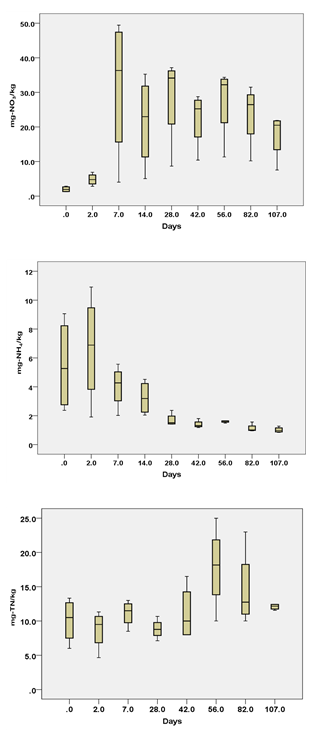
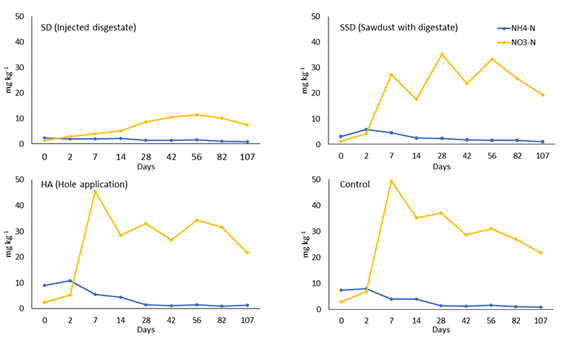
Addition of pig-digestate in this study resulted an increase of NH4-N contents from day 0 to day 2 (Figs. 1 and 3), and rapid decrease after 7 days, when it dropped at day 28 almost close to zero and stayed fairly constant until the end of incubation. The concentration of NO3-N exceeded the NH4-N content at day 7 designating the quick N changes. This implies that the major form of soil inorganic nitrogen was from ammonium-N and it resulted a consequence of organic-N mineralization during the AD process (Möller, 2012). A similar pattern was observed with the studies of Möller and Müller (2012). Nitrogen was rapidly assimilated by plants when feedstocks had higher ratios of NH4-N out of the total nitrogen (Sawada and Toyota, 2015). The results showed that time and digestate affected the N cycle in the soil (ANOVA F5.311 = 17.100, p = 0.00). Initially, total nitrogen contents are fluctuated along the time at p < 0.05 (ANOVA F2.727 = 34.695, p = 0.024) but not significantly important. K2SO4-extractable total nitrogen (ETN) contents were statistically different from NO3-N during all the incubation experiments, showing that the contribution of NH4-N and labile organic N to ETN were not negligible. It can be influenced by some factors such as different application types, application rate, soil type, and the condition of the soil. Most nitrogen losses occur after field application and take various routes like mineralization, volatilization, nitrification and denitrification (Plante et al., 2007). Without soil incorporation or the use of special technique of application or alternatives methods, environmental indicators can be suggested to time the application of manure for holding organic N.
2. Influence of biogas digestate technique of application methods on NH4-N loss
The NH4-N concentration in the 0~10 cm soil depth amplified significantly after N amendment. The maximum means of ammonium was observed in the soil-applied with injected digestate SD (4.056 ± 3.755 mg N⋅kg-1), compared to SSD 2.69 ± 1.53 mg N/kg and HA 3.30 ± 2.77mg N/kg. After 28 days to the end of incubation, soil NH4-N content was approximately similar and reliably lower than 2.0 mg NH4-N kg-1soil applied with SD, HA, and SSD, respectively. During day 28 to day 107 of incubation period, there were no significant differences (P < 0.05) between SD ˃ HA ˃ SSD ˃ control (ANOVA (F1.57 = 9.567, p = 0.216). In control without biogas digestate application, the soil NH4-N contents rose slowly during 14 days and thereafter decreased at day 28 to less than 2.0 mg NH4-N Kg-1. The similar pattern was found in the sawdust application at day 42, unlike SD and HA application at this same day 28, specifying the lower nitrification in SSD than SD and HA. Bodirsky et al. (2014) and Reichel et al. (2018) have shown that most of the nitrogen in all organic fertilizers such manure or pig slurry were in the form of ammonium and furthermore increased the NH4-N content in the soil immediately generating the nitrification processes. These results are in line also with the works of Tampio et al. (2016) and have stipulated that in the beginning of the mineralization experiment, the soil nitrate concentration were low and the predominant form of soil inorganic nitrogen were NH4-N from the digestates. The decrease of NH4-N at day 7 have led to the increase of nitrate in the soil.
This explains that the nitrification in this study started after 7 days of incubation. In contrast to the results of all the digestates used in this study, nitrification of NH4-N to NO3-N started at fast rate in all digestate applications after a 4-day adaptation/immobilization period. Our study showed that the added N moved to the mineral N pool indicating mineralization followed by nitrification process. Immobilization N cannot be ignored in the previous stages of incubation, although most of the immobilized N was released into the mineral N pool after 14 days, as Abassi et al. (2015) explained. We have settled that under the experimental conditions, denitrification is the main mechanism of N loss occurring after nitrification of NH4-N. Some previous studies have demonstrated that the reduction of NO3-N leaching or ammonia emission can be counterbalanced with increasing NO2 emissions (Wang et al., 2019).
3. Effect of different technique of application methods on NO3-N leaching
The results showed that the NO3-N concentration gradually increased over the time till the end of incubation. In contrast to HA application indicated that the higher N net mineralization was followed by SD application than SSD and Control. At day 7 of incubation, soil NO3-N content was significantly (P < 0.05) higher after HA and SD application, representing the net nitrification rate were highest after HA application. Dynamics in NO3-N over time were parallel in response to the digestate application methods. The maximum peak concentration of NO3-N in soil took place for 7 days after incubation in HA application, 49.42 mg NO3-N Kg-1 following SD application, 45.40 mg NO3-N Kg-1. In the case of SSD application, the maximum concentration was at day 28, numbering 35.28 mg NO3-N Kg-1 due to its high organic C content and the recalcitrant compounds. The mean NO3-N contents in all the experiments had significant differences (p < 0.0001) for the samples removed on 28 and 56 days. The Tukey Kramer test showed no statistical difference (p > 0.05) between HA and SD application than SSD (p < 0.05) compared to control. In addition, the test of ANOVA showed a significant difference between the methods (ANOVA F5.37 = 746.97, p = 0.0041).
As reported from other studies, tillage incorporation, shallow injection, trailing hose or shoe are known to significantly reduce N losses due to nitrate leaching or ammonia volatilization compared to broadcast surface spreading (Huijsmans et al., 1997). Meanwhile, the reported research is very limited, accessible data advice in the best cases dealing with manure injection is not expected to conspicuously increase leaching losses if manure is applied at rates reliable with crop requirements. there are also only a few information about nitrate leaching in conjunction with subsurface manure application. Our findings enhanced the decrease of nitrate leaching in all the pig digestate application methods, although it could have been more effective with the sawdust application. Nevertheless, continuous temperature and moisture fluctuation under laboratory conditions might affect the efficiency of these techniques and the potential rate of mineralization. The process of mineralization of organic matter increases the rate of ammonium and nitrate in the soil; however, NO3-N highly mobile is poorly taken by soil particles and prone to loss. In numerous states, nitrate leaching from pig manure is a pertinent environmental issue. It can lead to the adverse effects of underground water and streams.
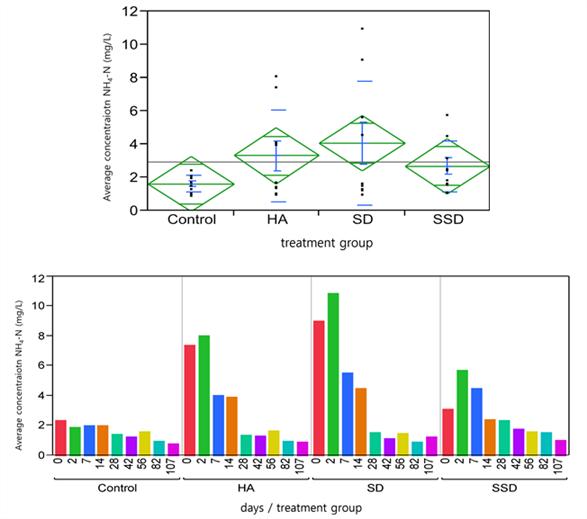
Fig. 2
Fate of NH4-N in different application methods after 0, 7, 14, 28, 42, 56, 82 and 107 of incubation
In the present study, the addition of sawdust to the soil with digestate lowered the N net mineralization content. In general, when organic amendments with a C/N ratio higher than 20 are mixed into the soil, net N uptake by the microbiota dominates (Alburquerque et al., 2012). In time, when the easily mineralized organic carbon is depleted, the immobilization of N disappears. Lower nitrification rate in soils fertilized with SSD might be explained by lower pH values since nitrification is sensitive to pH and temperature. In accordance to Reichel et al. (2018), the spruce sawdust tended to lower the NO3-N in soil between 21 and 113 days after fertilization, but to a lower extent compared to wheat straw, around 30% of total decomposition till the end of incubation, no clear decomposition trend until 49 days. Despite constant NO3-N release of re-mineralized microbial N throughout the entire incubation, less pronounced and late sawdust, tended to reduce soil NO3- content at time scale. The observed NO3-N mitigation could be a consequence of outcompeting nitrifiers and denitrifiers by zymogenous N immobilizers (Burger and Jackson, 2003), as indicated by data of (Reichel et al., 2018). Hence, HCA such as wheat straw and spruce sawdust with high C content have the potential to mitigate NO3- losses if applied to soil in the right amount and under conditions suitable for large microbial competition for mineral N. The application of sawdust, can potentially retain 9 kg N ha-1 for more than 4 months, which, along with nitrogen uptake from winter crops, could offset the nitrogen extras naturally establish in fields after harvest (Möller, 2008).
4. Effect of biogas digestate methods on total nitrogen loss
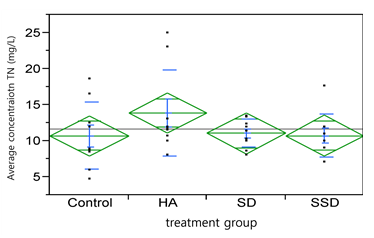
Soil N accumulation resulted in rises in extractable total nitrogen (TN), which remained at nearly constant levels during the entire experiment in Control and different method of application (Sawada and Toyota, 2015). The TN contents was steady through the incubation time and equal to 10.71 ± 4.643 g-N kg-1 and 10.75 ± 3.034 g-N kg-1 in control and SSD, respectively. The maximum peak of mean TN concentration was observed in the HA 13.89 ± 5.923 g-N kg-1 significantly higher than the value obtained to control and SSD, following by SD, 11.06 ± 1.956 g-N kg-1. However, there is no statistically significant difference between the different techniques of application methods of digestate (ANOVA F1.22= 21.224, p = 0.319) p ˃ 0.05 and same argument with Kruskal Wallis test of performance p = 0.55. In addition, Kruskal Wallis test also indicates that there is no significant difference and distribution of TN with time (p = 0.092). The continuous of soil TN contents could be due to the inexistence of crops and types of crops or soil conditions.
5. Electrical conductivity and pH
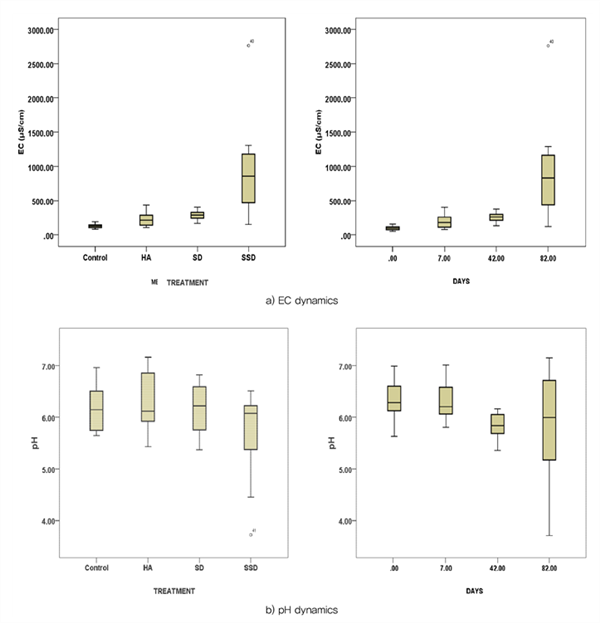
Soil electrical conductivity (EC) revealed the outline of NO3-N in all experiments as well as in the control. EC in control was 97.86 ± 23.76 µS cm-1 at Day 0 and rose rapidly to 110.80 ± 1.80 µS cm-1 at day 7 of incubation and then to 305.93 ± 261.10 µS cm-1 at the end of the experiment. After 14 days of incubation, both (methods and control) were increased until the end of incubation at room temperature. In all experiments, the EC values were influenced by time, mounting through the incubation (ANOVA F11.917= 1538767.21, p = 0.00). EC values during incubation time were not affected by either fertilizer or methods (ANOVA F1.240= 269886.57, p = 0.307). This is in agreement with the results of Wysocka-Czubaszek (2019). Electrical conductivity levels can be assisted as an indirect indicator of the amount of water and water-soluble nutrients available for plant uptake such as nitrate-N. Areas of saline soils need to be identified and managed differently from areas of non-saline soils. Soil microorganism activity declines as EC increases. This hinders important soil processes such as respiration, residue decomposition, nitrification, and denitrification. However, the values of pH were increased slightly (not significantly, p > 0.05) in all the soil samples, compared to control (5.81 ± 0.027), after adding the digestate (Fig. 5). Also, a slight change in the pH values between control and experiment results had been observed during the first 42 days of incubation. After this period soil pH increased slowly to very similar values for all applications and stayed at this level.
Ⅳ. CONCLUSION
Our study highlighted that animal digestate can provide a huge amount of NH4-N to the soil regardless of feedstock used as AD, which can quickly transform it to nitrate form. This suggests that good management of manure land application should minimize potential nitrate leaching, which can also occur early in the growing season or after harvest. The overall pattern of ammonium and total nitrogen fate in the soil fertilized with manure showed no statistically significant (p > 0.05) differences between the different methods applied during the incubation time under room temperature. In contrast, NO3-N concentration indicates significant reduction in sawdust treatment (p < 0.05) compared to the control and other application methods. However, the soil sawdust mixed with digestate was more effective than the other methods, because of the cumulative labile C contents of the amendment, which implies soil net N immobilization. The advantages of N immobilization could be enhanced by joining HCA (High Organic Carbon Amendment) with properties similar to sawdust.
In our experiment, spruce sawdust was able to hold N sufficiently long time for the microbial and HCA deposit pool to aid as an additive supply of nitrogen for next crop growth. Likewise, we assume that HCA diminishes N losses in form of NO3-N. Application of HCA like sawdust to inorganic N-rich soil in the short term increases CO2 and N2O emissions, but these are offset by benefits such as nitrogen immobilization and attenuation of NO3-N loss potential. In the nutshell, HCA applications can be included with a set of new agricultural cropping approaches aimed at improving the nitrogen use efficiency of agricultural production, without loss of crops yield and sustainability.
This study could help to improve digestate management programs to meet crop N needs and nitrogen use efficiency while mitigating nitrate loss impacts regarding groundwater and atmosphere pollution. Future researches are needed to optimize the sawdust based on its composition, rate and particle size. By optimizing the following traits we can avoid N immobilization, re-release N at the right time and precisely estimate the necessary rate. The considerable changeability in the effectiveness of these techniques of nitrate leaching requires further investigation.